교과서 질문
One of the chair conformers of cis-1,3-dimethylcyclohexane is 5.4 kcal/mol less stable than the other. How much steric strain does a 1,3-diaxial interaction between two methyl groups introduce into the conformer?
1417
views

 Bruice 8th EditionCh. 3 - An Introduction to Organic Compounds: Nomenclature, Physical Properties, and Structure문제 87c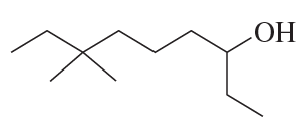
 검증된 단계별 안내
One of the chair conformers of cis-1,3-dimethylcyclohexane is 5.4 kcal/mol less stable than the other. How much steric strain does a 1,3-diaxial interaction between two methyl groups introduce into the conformer?
Name the following compounds:
b.
Using the data obtained in Problem 81, calculate the percentage of molecules of trans-1,2-dimethylcyclohexane that will have both methyl groups in equatorial positions.
Bromine is a larger atom than chlorine, but the equilibrium constants in Table 3.9 indicate that a chloro substituent has a greater preference for the equatorial position than does a bromo substituent. Suggest an explanation for this fact.
Using the data obtained in Problem 85, calculate the amount of steric strain in each of the chair conformers of 1,1,3-trimethylcyclohexane. Which conformer predominates at equilibrium?
Draw the conformers for the following trisubstituted cyclohexane. Calculate the strain energy of each conformer. (The gauche interaction between a methyl and an ethyl group is 0.96 kcal/mol; the 1,3-diaxial interaction between a methyl and an H is 0.87 kcal/mol and between an ethyl and an H is 1.00 kcal/mol.)