Calculate the percentage of isopropylcyclohexane molecules that have the isopropyl substituent in an equatorial position at equilibrium. (Its ∆G° value at 25 °C is -2.1 kcal/mol.)
Ch. 5 - Alkenes: Structure, Nomenclature, and an Introduction to Reactivity • Thermodynamics and Kinetics
모든 교과서
Bruice 8th Edition
Ch. 5 - Alkenes: Structure, Nomenclature, and an Introduction to Reactivity • Thermodynamics and Kinetics
문제 16a,b
Bruice 8th Edition
Ch. 5 - Alkenes: Structure, Nomenclature, and an Introduction to Reactivity • Thermodynamics and Kinetics
문제 16a,b5장, 문제 16a,b
For each of the reactions in Problem 15, indicate which reactant is the nucleophile and which is the electrophile.
a. 
b. 
검증된 단계별 안내1
Step 1: Analyze the reaction in part A. The reactants are formic acid (HCOOH) and hydronium ion (H3O+). Formic acid has a carbonyl group with a partial positive charge on the carbon atom, making it an electrophile. The hydronium ion (H3O+) has lone pairs on oxygen, making it a nucleophile.
Step 2: In part A, the nucleophile (H3O+) donates a lone pair of electrons to the electrophilic carbon atom of formic acid, resulting in the formation of a protonated formic acid and water as products.
Step 3: Analyze the reaction in part B. The reactants are cyclopentene and bromonium ion (Br+). Cyclopentene has a double bond, which is electron-rich and can act as a nucleophile. The bromonium ion (Br+) is electron-deficient and acts as an electrophile.
Step 4: In part B, the nucleophile (cyclopentene) donates electrons from its double bond to the electrophilic bromonium ion (Br+), forming a brominated cyclopentane product.
Step 5: Summarize the roles: In part A, H3O+ is the nucleophile and HCOOH is the electrophile. In part B, cyclopentene is the nucleophile and Br+ is the electrophile.

비슷한 문제에 대한 검증된 영상 답변:
이 영상 해법은 위 문제에 도움이 된다고 튜터들이 추천한 것입니다.
영상 길이:
5m도움이 되었나요?
주요 개념
질문에 올바르게 답하기 위해 반드시 이해해야 하는 핵심 개념들은 다음과 같습니다.
Nucleophile
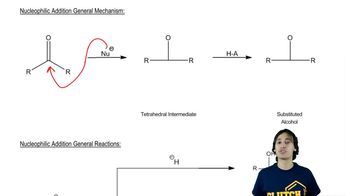
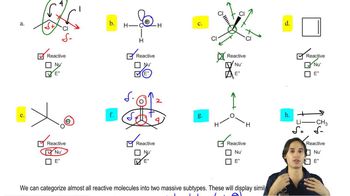
A nucleophile is a species that donates an electron pair to form a chemical bond in a reaction. Nucleophiles are typically negatively charged or neutral molecules with lone pairs of electrons. In the provided reactions, nucleophiles attack electrophiles, facilitating the formation of new bonds.
추천 영상:
Nucleophilic Addition
Electrophile
An electrophile is a chemical species that accepts an electron pair from a nucleophile during a reaction. Electrophiles are often positively charged or electron-deficient molecules. They are attracted to nucleophiles due to their electron-rich nature, making them key players in many organic reactions.
추천 영상:
Nucleophile or Electrophile
Reaction Mechanism
A reaction mechanism describes the step-by-step process by which reactants are converted into products. It includes the identification of nucleophiles and electrophiles, as well as the transition states and intermediates involved. Understanding the mechanism is crucial for predicting the outcome of reactions and the stability of intermediates.
추천 영상:
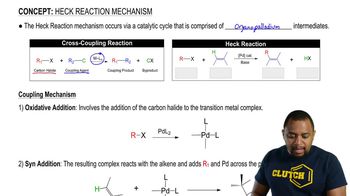
Heck Reaction Mechanism
관련 실천
교과서 질문
1448
views
교과서 질문
Calculate ∆G° for the conversion of “axial” methylcyclohexane to “equatorial” methylcyclohexane at 25 °C.
1311
views
교과서 질문
The ∆G° for conversion of “axial” fluorocyclohexane to “equatorial” fluorocyclohexane at 25 °C is -0.25kcal/mol. Calculate the percentage of fluorocyclohexane molecules that have the fluoro substituent in an equatorial position at equilibrium.
1151
views
교과서 질문
Use curved arrows to show the movement of electrons in the following reaction steps
a.
b.
2806
views
교과서 질문
Identify the nucleophile and the electrophile in the following acid–base reactions:
a.
b.
3016
views
교과서 질문
Draw the isomers for the following compounds and then name each one:
c. 1,3-pentadiene
1380
views