Ch. 5 - Alkenes: Structure, Nomenclature, and an Introduction to Reactivity • Thermodynamics and Kinetics
Bruice - Organic Chemistry 8th Edition
Bruice8th EditionOrganic ChemistryISBN: 9780135213711당신이 사용하는 게 아니라요?교과서 변경
5장, 문제 14

Identify the nucleophile and the electrophile in the following acid–base reactions:
a. Chemical reaction showing AlCl3 and NH3 forming a complex, indicating nucleophile and electrophile roles.
b. Chemical equation illustrating an acid-base reaction with nucleophile and electrophile identified.

검증된 단계별 안내
1
Step 1: Understand the concept of nucleophiles and electrophiles. A nucleophile is an electron-rich species that donates a pair of electrons, while an electrophile is an electron-deficient species that accepts a pair of electrons.
Step 2: Analyze reaction A. In the reaction BH₃ + NH₃ ⇌ H₃B⁻NH₃⁺, BH₃ is electron-deficient due to the incomplete octet of boron, making it the electrophile. NH₃ has a lone pair of electrons on nitrogen, making it the nucleophile.
Step 3: Analyze reaction B. In the reaction HCl + OH⁻ ⇌ Cl⁻ + H₂O, HCl acts as the electrophile because the hydrogen atom is electron-deficient and can accept a pair of electrons. OH⁻ is the nucleophile because it has a lone pair of electrons and a negative charge, making it electron-rich.
Step 4: Recognize the acid-base nature of these reactions. In reaction A, NH₃ acts as a Lewis base (electron donor), and BH₃ acts as a Lewis acid (electron acceptor). In reaction B, OH⁻ acts as a Bronsted-Lowry base (proton acceptor), and HCl acts as a Bronsted-Lowry acid (proton donor).
Step 5: Summarize the identification. For reaction A, NH₃ is the nucleophile and BH₃ is the electrophile. For reaction B, OH⁻ is the nucleophile and HCl is the electrophile.

비슷한 문제에 대한 검증된 영상 답변:

이 영상 해법은 위 문제에 도움이 된다고 튜터들이 추천한 것입니다.
영상 길이:
5m

주요 개념

질문에 올바르게 답하기 위해 반드시 이해해야 하는 핵심 개념들은 다음과 같습니다.

Nucleophile

A nucleophile is a species that donates an electron pair to form a chemical bond in a reaction. Nucleophiles are typically negatively charged or neutral molecules with lone pairs of electrons. In the provided reactions, nucleophiles such as NH3 and OH- attack electrophiles, facilitating the formation of new bonds.
추천 영상:
08:27
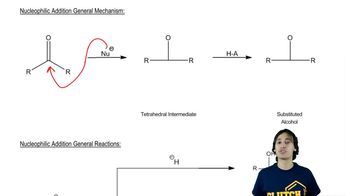
Nucleophilic Addition

Electrophile

An electrophile is a chemical species that accepts an electron pair from a nucleophile during a reaction. Electrophiles are often positively charged or electron-deficient molecules. In the given reactions, BH3 and HCl act as electrophiles, as they are capable of accepting electron pairs from nucleophiles like NH3 and OH-, respectively.
추천 영상:
03:
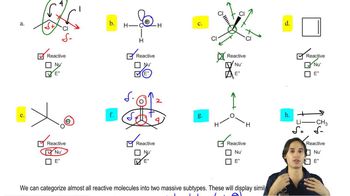
Nucleophile or Electrophile

Acid-Base Reactions

Acid-base reactions involve the transfer of protons (H+) between reactants, where acids donate protons and bases accept them. These reactions can also be viewed through the lens of nucleophiles and electrophiles, as bases often act as nucleophiles and acids as electrophiles. Understanding this relationship is crucial for identifying the roles of different species in the provided reactions.
추천 영상:
02:49
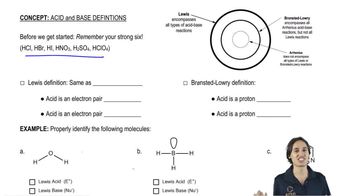
The Lewis definition of acids and bases.