Ch. 5 - Alkenes: Structure, Nomenclature, and an Introduction to Reactivity • Thermodynamics and Kinetics
Bruice - Organic Chemistry 8th Edition
Bruice8th EditionOrganic ChemistryISBN: 9780135213711당신이 사용하는 게 아니라요?교과서 변경
5장, 문제 33b

From the Arrhenius equation, predict how
b. increasing the temperature affects the rate constant for a reaction.

검증된 단계별 안내
1
Understand the Arrhenius equation: The Arrhenius equation is given by \( k = A e^{-\frac{E_a}{RT}} \), where \( k \) is the rate constant, \( A \) is the pre-exponential factor, \( E_a \) is the activation energy, \( R \) is the gas constant, and \( T \) is the temperature in Kelvin.
Identify the role of temperature: In the Arrhenius equation, temperature \( T \) appears in the denominator of the exponent. This means that as \( T \) increases, the value of \( \frac{E_a}{RT} \) decreases.
Analyze the exponential factor: Since \( \frac{E_a}{RT} \) decreases with an increase in \( T \), the exponent \( -\frac{E_a}{RT} \) becomes less negative. This results in a larger value of the exponential term \( e^{-\frac{E_a}{RT}} \).
Conclude the effect on the rate constant: As the exponential term increases, the overall rate constant \( k \) also increases. This is because the rate constant is directly proportional to the exponential term in the Arrhenius equation.
Summarize the temperature effect: Increasing the temperature leads to an increase in the rate constant for a reaction, which implies that the reaction will proceed at a faster rate at higher temperatures.

비슷한 문제에 대한 검증된 영상 답변:

이 영상 해법은 위 문제에 도움이 된다고 튜터들이 추천한 것입니다.
영상 길이:
2m
도움이 되었나요?

주요 개념

질문에 올바르게 답하기 위해 반드시 이해해야 하는 핵심 개념들은 다음과 같습니다.

Arrhenius Equation

The Arrhenius equation describes the temperature dependence of reaction rates, expressed as k = A * e^(-Ea/RT). Here, k is the rate constant, A is the pre-exponential factor, Ea is the activation energy, R is the gas constant, and T is the temperature in Kelvin. This equation illustrates how the rate constant increases with temperature, as higher temperatures provide more energy to overcome the activation barrier.
추천 영상:
05:02
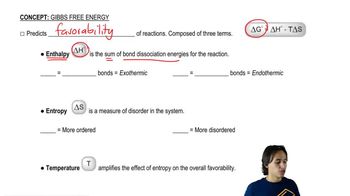
Breaking down the different terms of the Gibbs Free Energy equation.

Activation Energy (Ea)

Activation energy is the minimum energy required for a chemical reaction to occur. It represents the energy barrier that reactants must overcome to form products. In the context of the Arrhenius equation, a lower activation energy leads to a higher rate constant at a given temperature, meaning that reactions with lower Ea are faster, especially as temperature increases.
추천 영상:
가이드 코스
3:22
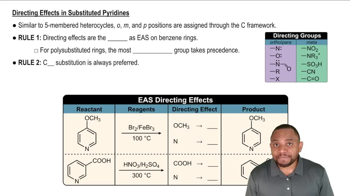
EAS Reactions of Pyridine Concept 3

Temperature and Reaction Rate

Temperature significantly influences the rate of chemical reactions. As temperature increases, the kinetic energy of molecules also increases, leading to more frequent and effective collisions between reactants. According to the Arrhenius equation, this results in an increase in the rate constant (k), thereby accelerating the reaction rate, as more molecules have sufficient energy to overcome the activation energy barrier.
추천 영상:
가이드 코스
5:07
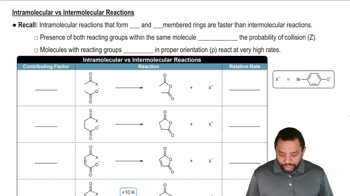
Rates of Intramolecular Reactions Concept 2
관련 실천
교과서 질문

From the Arrhenius equation, predict how

a. increasing the experimental activation energy affects the rate constant for a reaction.

1152
views

교과서 질문

The rate constant for a reaction can be increased by ______ the stability of the reactant or by ______ the stability of the transition state.

1094
views
교과서 질문

Draw a reaction coordinate diagram for a two-step reaction in which the first step is endergonic, the second step is exergonic, and the overall reaction is endergonic. Label the reactants, products, intermediates, and transition states.

1517
views
교과서 질문

a. Which step in the reaction coordinate diagram shown here has the greatest free energy of activation in the forward direction?

b. Is the first-formed intermediate more apt to revert to reactants or go on to form products?

c. Which step is the rate-determining step of the reaction?

<IMAGE>

2091
views
2
rank
교과서 질문

The rate of the reaction of methyl chloride with hydroxide ion is linearly dependent on both the concentration of methyl chloride and the concentration hydroxide ion. At 30 °C, the constant (k) for the reaction is 1.0 × 10⁻⁵ M-1 s-1

b. If the concentration of methyl chloride is decreased to 0.010 M, what will be the effect on

1. the rate of the reaction?

2. the rate constant for the reaction?

1503
views
교과서 질문

a. Which reaction has a greater equilibrium constant: one with a rate constant of 1 × 10⁻³ sec-1 for the forward reaction and a rate constant of 1 × 10⁻⁵ sec-1 for the reverse reaction, or one with a rate constant of 1 × 10⁻² sec-1 for the forward reaction and a rate constant of 1 × 10⁻³ sec-1 for the reverse reaction?

b. If both reactions start with a reactant concentration of 1.0 M, which reaction will form the most product when the reactions have reached equilibrium?

1664
views