Ch. 5 - Alkenes: Structure, Nomenclature, and an Introduction to Reactivity • Thermodynamics and Kinetics
Bruice - Organic Chemistry 8th Edition
Bruice8th EditionOrganic ChemistryISBN: 9780135213711당신이 사용하는 게 아니라요?교과서 변경
5장, 문제 32

The rate constant for a reaction can be increased by ______ the stability of the reactant or by ______ the stability of the transition state.

검증된 단계별 안내
1
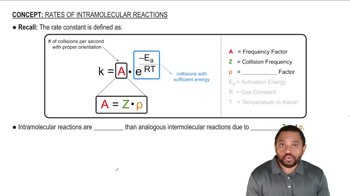
Identify the relationship between the rate constant and the activation energy using the Arrhenius equation: k = Ae^{-Ea/RT}, where k is the rate constant, A is the pre-exponential factor, Ea is the activation energy, R is the gas constant, and T is the temperature.
Understand that the activation energy (Ea) is the energy barrier that must be overcome for a reaction to proceed. Lowering the activation energy increases the rate constant.
Recognize that increasing the stability of the reactant typically increases the activation energy, as the reactant is at a lower energy state, making it harder to reach the transition state.
Realize that increasing the stability of the transition state lowers the activation energy, as the energy difference between the reactant and the transition state is reduced.
Conclude that the rate constant for a reaction can be increased by decreasing the stability of the reactant or by increasing the stability of the transition state.

비슷한 문제에 대한 검증된 영상 답변:

이 영상 해법은 위 문제에 도움이 된다고 튜터들이 추천한 것입니다.
영상 길이:
4m

주요 개념

질문에 올바르게 답하기 위해 반드시 이해해야 하는 핵심 개념들은 다음과 같습니다.

Rate Constant

The rate constant (k) is a proportionality factor in the rate equation of a chemical reaction, indicating how quickly a reaction proceeds. It is influenced by factors such as temperature, concentration, and the nature of the reactants. A higher rate constant signifies a faster reaction, while a lower rate constant indicates a slower reaction.
추천 영상:
가이드 코스
2:29
Rates of Intramolecular Reactions Concept 1

Stability of Reactants

The stability of reactants refers to their energy state and tendency to undergo a reaction. More stable reactants have lower energy and are less likely to react, while less stable reactants are more reactive. Enhancing the stability of reactants can lead to a decrease in the rate of reaction, as they are less inclined to transition into products.
추천 영상:
05:58
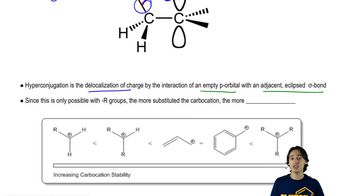
Determining Carbocation Stability

Transition State

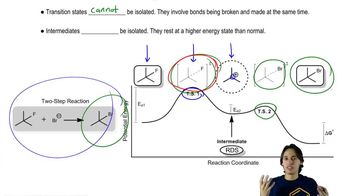
The transition state is a high-energy, unstable arrangement of atoms that occurs during the transformation from reactants to products. It represents the peak of the energy barrier that must be overcome for a reaction to proceed. Increasing the stability of the transition state lowers the activation energy, thereby increasing the rate constant and accelerating the reaction.
추천 영상:
06:55
Intermediates vs. Transition States
관련 실천
교과서 질문

Draw a reaction coordinate diagram for a reaction in which

a. the product is thermodynamically unstable and kinetically unstable.

b. the product is thermodynamically unstable and kinetically stable.

1443
views

교과서 질문

From the Arrhenius equation, predict how

b. increasing the temperature affects the rate constant for a reaction.

1119
views
교과서 질문

Convert the following perspective formulas to Fischer projections.

(c)

(d)

1291
views
교과서 질문

From the Arrhenius equation, predict how

a. increasing the experimental activation energy affects the rate constant for a reaction.

1152
views
교과서 질문

The rate of the reaction of methyl chloride with hydroxide ion is linearly dependent on both the concentration of methyl chloride and the concentration hydroxide ion. At 30 °C, the constant (k) for the reaction is 1.0 × 10⁻⁵ M-1 s-1

b. If the concentration of methyl chloride is decreased to 0.010 M, what will be the effect on

1. the rate of the reaction?

2. the rate constant for the reaction?

1503
views
교과서 질문

a. Which reaction has a greater equilibrium constant: one with a rate constant of 1 × 10⁻³ sec-1 for the forward reaction and a rate constant of 1 × 10⁻⁵ sec-1 for the reverse reaction, or one with a rate constant of 1 × 10⁻² sec-1 for the forward reaction and a rate constant of 1 × 10⁻³ sec-1 for the reverse reaction?

b. If both reactions start with a reactant concentration of 1.0 M, which reaction will form the most product when the reactions have reached equilibrium?

1664
views