Ch. 5 - Alkenes: Structure, Nomenclature, and an Introduction to Reactivity • Thermodynamics and Kinetics
Bruice - Organic Chemistry 8th Edition
Bruice8th EditionOrganic ChemistryISBN: 9780135213711당신이 사용하는 게 아니라요?교과서 변경
5장, 문제 7e,f

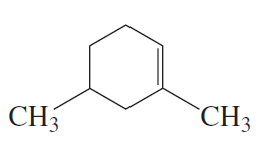
What is each compound's systematic name?
e. Chemical structure of a cycloalkane with two methyl groups attached, labeled CH3 on either side.
f. Chemical structure of an alkene with a double bond and a long carbon chain, labeled with its molecular formula.

검증된 단계별 안내
1
Step 1: Analyze the structure of each compound provided in the problem. Look for functional groups, the longest carbon chain, and any substituents attached to the main chain.
Step 2: Identify the parent chain (the longest continuous chain of carbon atoms) for each compound. This will form the base of the systematic name.
Step 3: Determine the functional groups present in each compound and their priority according to IUPAC nomenclature rules. Functional groups with higher priority will influence the suffix of the name.
Step 4: Number the carbon atoms in the parent chain, starting from the end that gives the substituents and functional groups the lowest possible numbers. Assign locants (numbers) to each substituent and functional group.
Step 5: Combine the information into the systematic name for each compound, starting with the substituents (in alphabetical order), followed by the parent chain, and ending with the suffix for the functional group.

비슷한 문제에 대한 검증된 영상 답변:

이 영상 해법은 위 문제에 도움이 된다고 튜터들이 추천한 것입니다.
영상 길이:
4m
도움이 되었나요?

주요 개념

질문에 올바르게 답하기 위해 반드시 이해해야 하는 핵심 개념들은 다음과 같습니다.

IUPAC Nomenclature

IUPAC nomenclature is a systematic method for naming organic chemical compounds. It provides a set of rules to create unique names based on the structure of the molecule, including the longest carbon chain, functional groups, and substituents. Understanding these rules is essential for accurately identifying and communicating the identity of compounds.
추천 영상:
가이드 코스
03:43
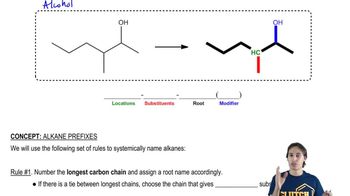
The different parts of an IUPAC name

Functional Groups

Functional groups are specific groups of atoms within molecules that are responsible for the characteristic chemical reactions of those molecules. Common functional groups include alcohols, carboxylic acids, and amines. Recognizing functional groups is crucial for determining the properties and reactivity of organic compounds, which directly influences their systematic naming.
추천 영상:
가이드 코스
02:36
Identifying Functional Groups

Structural Isomerism

Structural isomerism occurs when compounds have the same molecular formula but different structural arrangements of atoms. This can lead to different physical and chemical properties, making it important to specify the correct structure when naming a compound. Understanding isomerism is vital for accurately determining the systematic names of compounds, as different structures can yield different names.
추천 영상:
가이드 코스
06:47
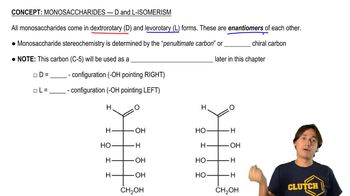
Monosaccharides - D and L Isomerism