
Ch. 5 - Alkenes: Structure, Nomenclature, and an Introduction to Reactivity • Thermodynamics and Kinetics
Bruice - Organic Chemistry 8th Edition
Bruice8th EditionOrganic ChemistryISBN: 9780135213711당신이 사용하는 게 아니라요?교과서 변경
5장, 문제 38

Which of the following parameters would be different for a reaction carried out in the presence of a catalyst compared with the same reaction carried out in the absence of a catalyst?
∆G°, ∆H‡, Ea, ∆S‡, ∆H°, Keq, ∆G‡, ∆S°, k

검증된 단계별 안내
1
Step 1: Understand the role of a catalyst in a chemical reaction. A catalyst speeds up the reaction by providing an alternative pathway with a lower activation energy (Ea), but it does not alter the thermodynamic properties of the reaction such as ∆G°, ∆H°, ∆S°, or Keq.
Step 2: Identify the parameters that are directly affected by the presence of a catalyst. The activation energy (Ea) and the Gibbs free energy of activation (∆G‡) are reduced because the catalyst lowers the energy barrier for the reaction.
Step 3: Recognize that the enthalpy of activation (∆H‡) and entropy of activation (∆S‡) may also change because the catalyst modifies the transition state of the reaction, altering the energy and molecular arrangement required to reach it.
Step 4: Note that thermodynamic parameters such as ∆G°, ∆H°, ∆S°, and the equilibrium constant (Keq) remain unchanged because a catalyst does not affect the overall energy difference between reactants and products or the position of equilibrium.
Step 5: Conclude that the parameters affected by the presence of a catalyst are Ea, ∆G‡, ∆H‡, and ∆S‡, while ∆G°, ∆H°, ∆S°, Keq, and the rate constant (k) are indirectly influenced through the reduction in activation energy, leading to an increased reaction rate.

비슷한 문제에 대한 검증된 영상 답변:

이 영상 해법은 위 문제에 도움이 된다고 튜터들이 추천한 것입니다.
영상 길이:
6m

주요 개념

질문에 올바르게 답하기 위해 반드시 이해해야 하는 핵심 개념들은 다음과 같습니다.

Activation Energy (Ea)

Activation energy (Ea) is the minimum energy required for a chemical reaction to occur. A catalyst lowers the activation energy, allowing the reaction to proceed more easily and quickly. This means that while the overall energy change of the reaction remains the same, the presence of a catalyst alters the energy barrier that must be overcome for the reaction to take place.
추천 영상:
가이드 코스
3:22
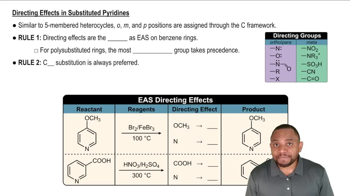
EAS Reactions of Pyridine Concept 3

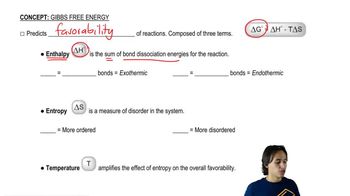
Gibbs Free Energy (∆G°)

Gibbs free energy (∆G°) is a thermodynamic potential that indicates the spontaneity of a reaction at standard conditions. It is not affected by the presence of a catalyst, as catalysts do not change the overall energy difference between reactants and products. Therefore, while catalysts speed up reactions, they do not alter the Gibbs free energy change of the reaction.
추천 영상:
05:02
Breaking down the different terms of the Gibbs Free Energy equation.

Transition State Theory (∆H‡ and ∆S‡)

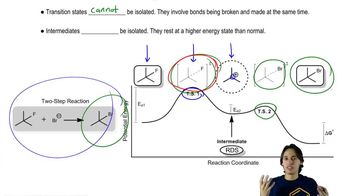
Transition state theory describes the high-energy state that occurs during a chemical reaction, characterized by enthalpy (∆H‡) and entropy (∆S‡) changes. A catalyst stabilizes the transition state, which can lower both the enthalpy and entropy of activation, thus facilitating the reaction. This means that while the overall reaction parameters remain unchanged, the activation parameters are significantly affected by the presence of a catalyst.
추천 영상:
06:55
Intermediates vs. Transition States