뒤로
뒤로 Bruice 8th EditionCh. 5 - Alkenes: Structure, Nomenclature, and an Introduction to Reactivity • Thermodynamics and Kinetics
문제 24b
What alkene would you start with if you wanted to synthesize
b. ethylcyclopentane?
문제 25a,b
How many different alkenes can be hydrogenated to form
a. butane?
b. 3-methylpentane?
문제 26
The same alkane is obtained from the catalytic hydrogenation of both alkene A and alkene B. The heat of hydrogenation of alkene A is 29.8 kcal/mol, and the heat of hydrogenation of alkene B is 31.4 kcal/mol. Which alkene is more stable?
문제 28
Rank the following compounds from most stable to least stable:
trans-3-hexene, cis-3-hexene, cis-2,5-dimethyl-3-hexene, (Z)-3,4-dimethyl-3-hexene
문제 28c,d
Convert the following perspective formulas to Fischer projections.
(c)
(d)
문제 30
Draw a reaction coordinate diagram for a reaction in which
a. the product is thermodynamically unstable and kinetically unstable.
b. the product is thermodynamically unstable and kinetically stable.
문제 31b
The rate of the reaction of methyl chloride with hydroxide ion is linearly dependent on both the concentration of methyl chloride and the concentration hydroxide ion. At 30 °C, the constant (k) for the reaction is 1.0 × 10⁻⁵ M-1 s-1
b. If the concentration of methyl chloride is decreased to 0.010 M, what will be the effect on
1. the rate of the reaction?
2. the rate constant for the reaction?
문제 32
The rate constant for a reaction can be increased by ______ the stability of the reactant or by ______ the stability of the transition state.
문제 33a
From the Arrhenius equation, predict how
a. increasing the experimental activation energy affects the rate constant for a reaction.
문제 33b
From the Arrhenius equation, predict how
b. increasing the temperature affects the rate constant for a reaction.
문제 34a,b
a. Which reaction has a greater equilibrium constant: one with a rate constant of 1 × 10⁻³ sec-1 for the forward reaction and a rate constant of 1 × 10⁻⁵ sec-1 for the reverse reaction, or one with a rate constant of 1 × 10⁻² sec-1 for the forward reaction and a rate constant of 1 × 10⁻³ sec-1 for the reverse reaction?
b. If both reactions start with a reactant concentration of 1.0 M, which reaction will form the most product when the reactions have reached equilibrium?
문제 35
Draw a reaction coordinate diagram for a two-step reaction in which the first step is endergonic, the second step is exergonic, and the overall reaction is endergonic. Label the reactants, products, intermediates, and transition states.
문제 36
a. Which step in the reaction coordinate diagram shown here has the greatest free energy of activation in the forward direction?
b. Is the first-formed intermediate more apt to revert to reactants or go on to form products?
c. Which step is the rate-determining step of the reaction?
<IMAGE>
문제 37a-d
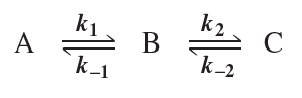
Draw a reaction coordinate diagram for the following reaction in which C is the most stable and B the least stable of the three species and the transition state going from A to B is more stable than the transition state going from B to C:
a. How many intermediates are there?
b. How many transition states are there?
c. Which step has the greater rate constant in the forward direction?
d. Which step has the greater rate constant in the reverse direction?
문제 38
Which of the following parameters would be different for a reaction carried out in the presence of a catalyst compared with the same reaction carried out in the absence of a catalyst?
∆G°, ∆H‡, Ea, ∆S‡, ∆H°, Keq, ∆G‡, ∆S°, k
문제 39a
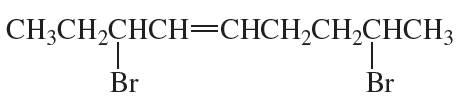
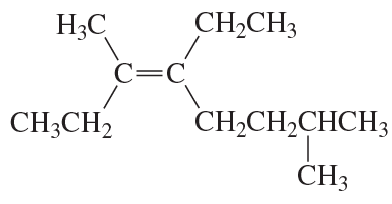
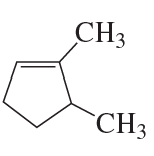
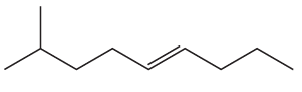
What is each compound's systematic name?
a.
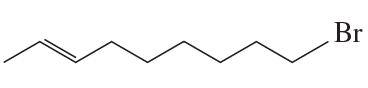
문제 39b
What is each compound's systematic name?
b.
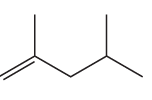
문제 39c
What is each compound's systematic name?
c.
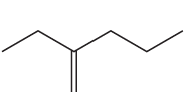
문제 39d,e,f
What is each compound's systematic name?
d.
e.
f.
문제 41
Draw the structure of a hydrocarbon that has six carbon atoms and
a. three vinylic hydrogens and two allylic hydrogens.
b. three vinylic hydrogens and one allylic hydrogen.
c. three vinylic hydrogens and no allylic hydrogens.
문제 42a,b,c
Draw the condensed structure for each of the following:
a. (Z)-1,3,5-tribromo-2-pentene
b. (Z)-3-methyl-2-heptene
c. (E)-1,2-dibromo-3-isopropyl-2-hexene
문제 42d,e,f
Draw the condensed structure for each of the following:
d. vinyl bromide
e. 1,2-dimethylcyclopentene
f. diallylamine
문제 43d,e,f
Draw the skeletal structures for the compounds in Problem 42.
d. vinyl bromide
e. 1,2-dimethylcyclopentene
f. diallylamine
문제 44
a. Draw the condensed structures and give the systematic names for all the alkenes with molecular formula C6H12, ignoring stereoisomers. (Hint: There are 13.)
b. Which of the alkenes have E and Z isomers?
c. Which of the alkenes is the most stable?
d. Which of the alkenes is the least stable?
문제 45a
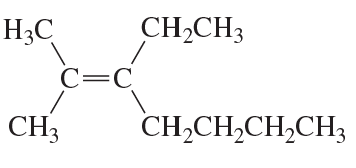
Name the following:
a.
문제 45b
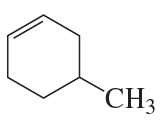
Name the following:
b.
문제 45c
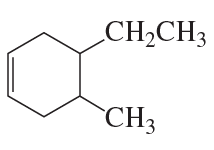
Name the following:
c.
문제 45d,e,f
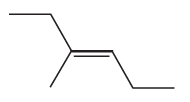
Name the following:
d.
e.
f.
문제 46a
Of the compounds you named in Problem 45:
a. Which is the most stable?
a.
b.
c.
d.
e.
f.
문제 46b
Of the compounds you named in Problem 45:
b. Which is the least stable?
a.
b.
c.
d.
e.
f.