A chemist is planning to synthesize 3-octyne by adding 1-bromobutane to the product obtained from the reaction of 1-butyne with sodium amide. Unfortunately, however, he forgot to order 1-butyne. How else can he prepare 3-octyne?
Ch. 7 - The Reactions of Alkynes • An Introduction to Multistep Synthesis
모든 교과서
Bruice 8th Edition
Ch. 7 - The Reactions of Alkynes • An Introduction to Multistep Synthesis
문제 54
Bruice 8th Edition
Ch. 7 - The Reactions of Alkynes • An Introduction to Multistep Synthesis
문제 547장, 문제 54
a. Explain why a single pure product is obtained from hydroboration–oxidation of 2-butyne, whereas two products are obtained from hydroboration–oxidation of 2-pentyne.
b. Name two other internal alkynes that yield only one product upon hydroboration–oxidation.
검증된 단계별 안내1
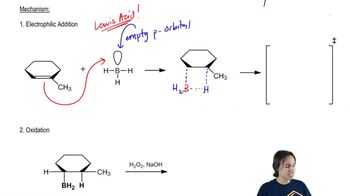
Hydroboration–oxidation of alkynes involves two steps: (1) addition of borane (BH₃ or a derivative) to the alkyne, and (2) oxidation of the resulting organoborane intermediate with hydrogen peroxide (H₂O₂) in a basic solution to form an alcohol. This reaction proceeds with anti-Markovnikov regioselectivity and syn addition.
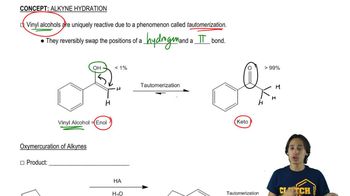
For 2-butyne, the molecule is symmetrical, meaning the two carbons in the triple bond are equivalent. As a result, the hydroboration step adds boron to one carbon and hydrogen to the other in a single, uniform manner. Upon oxidation, this leads to the formation of a single enol intermediate, which tautomerizes to a single ketone product (butan-2-one).
In contrast, 2-pentyne is an asymmetrical alkyne. The two carbons in the triple bond are not equivalent, so hydroboration can occur in two different ways, depending on which carbon the boron adds to. This results in two different enol intermediates, which tautomerize to two different ketones (pentan-2-one and pentan-3-one).
To identify other internal alkynes that yield only one product upon hydroboration–oxidation, we need to consider symmetrical alkynes. Symmetry ensures that the two carbons in the triple bond are equivalent, leading to a single product. Examples include 3-hexyne and 4-octyne, both of which are symmetrical internal alkynes.
In summary, the key factor determining whether one or two products are formed is the symmetry of the alkyne. Symmetrical alkynes like 2-butyne, 3-hexyne, and 4-octyne yield a single product, while asymmetrical alkynes like 2-pentyne yield two products due to the possibility of regioisomeric additions.

비슷한 문제에 대한 검증된 영상 답변:
이 영상 해법은 위 문제에 도움이 된다고 튜터들이 추천한 것입니다.
영상 길이:
5m주요 개념
질문에 올바르게 답하기 위해 반드시 이해해야 하는 핵심 개념들은 다음과 같습니다.
Hydroboration-Oxidation Mechanism
Hydroboration-oxidation is a two-step reaction involving the addition of borane (BH3) to an alkyne, followed by oxidation with hydrogen peroxide (H2O2) in a basic medium. This process results in the formation of alcohols, where the boron atom adds to the less substituted carbon of the alkyne, leading to syn-addition. The regioselectivity of this reaction is crucial in determining the number of products formed.
추천 영상:
Acid-catalyzed hydroboration-oxidation mechanism
Regioselectivity in Alkynes
Regioselectivity refers to the preference of a chemical reaction to yield one structural isomer over others. In the case of 2-butyne, the symmetrical nature of the molecule allows for only one product after hydroboration-oxidation, while 2-pentyne, being asymmetrical, can lead to two different products depending on which carbon the boron adds to. Understanding the structure of the alkyne is essential for predicting the outcome of the reaction.
추천 영상:
Alkyne Hydration
Internal Alkynes and Product Formation
Internal alkynes are those with the triple bond located between two carbon atoms, as opposed to terminal alkynes, which have the triple bond at the end. Certain internal alkynes, like 3-heptyne and 3-octyne, can yield only one product upon hydroboration-oxidation due to their symmetrical structure, which allows for a single regioselective addition of boron, resulting in a uniform product after oxidation.
추천 영상:
Alkyne Hydration
관련 실천
교과서 질문
1005
views
교과서 질문
What stereoisomers are obtained from the following reactions?
b.
1834
views
교과서 질문
Explain why, in hydroboration–oxidation, HO− and HOOH cannot be added until after the hydroboration reaction is over.
1745
views
교과서 질문
Show how each of the following compounds can be prepared using the given starting material, any needed inorganic reagents, and any organic compound that has no more than four carbons:
f.
793
views
교과서 질문
What stereoisomers are obtained from the following reactions?
1389
views
교과서 질문
Show how each of the following compounds can be prepared using the given starting material, any needed inorganic reagents, and any organic compound that has no more than four carbons:
e.
832
views