Ch. 7 - The Reactions of Alkynes • An Introduction to Multistep Synthesis
Bruice - Organic Chemistry 8th Edition
Bruice8th EditionOrganic ChemistryISBN: 9780135213711당신이 사용하는 게 아니라요?교과서 변경
7장, 문제 56

Explain why, in hydroboration–oxidation, HO and HOOH cannot be added until after the hydroboration reaction is over.

검증된 단계별 안내
1
Hydroboration–oxidation is a two-step reaction where the first step involves the addition of borane (BH₃ or its derivatives) to an alkene, forming an organoborane intermediate. This step is highly sensitive to the presence of nucleophiles like HO⁻ or HOOH.
In the hydroboration step, the borane molecule reacts with the alkene through a concerted mechanism, where the boron atom attaches to the less substituted carbon (anti-Markovnikov addition) and the hydrogen attaches to the more substituted carbon. This reaction requires a non-nucleophilic environment to proceed efficiently.
If HO⁻ (hydroxide ion) or HOOH (hydrogen peroxide) is present during the hydroboration step, they can react with borane, leading to side reactions such as the formation of borates or other byproducts. This would prevent the proper formation of the organoborane intermediate.
The oxidation step, which involves the addition of HOOH and HO⁻, is performed only after the hydroboration step is complete. In this step, the organoborane intermediate is oxidized to form the alcohol product. The presence of HOOH and HO⁻ at this stage is necessary to facilitate the oxidation reaction.
In summary, HO⁻ and HOOH are excluded during the hydroboration step to avoid interfering with the formation of the organoborane intermediate. They are introduced only in the oxidation step to ensure the reaction proceeds as intended.

비슷한 문제에 대한 검증된 영상 답변:

이 영상 해법은 위 문제에 도움이 된다고 튜터들이 추천한 것입니다.
영상 길이:
8m

주요 개념

질문에 올바르게 답하기 위해 반드시 이해해야 하는 핵심 개념들은 다음과 같습니다.

Hydroboration Reaction

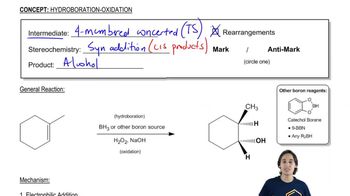
Hydroboration is a chemical reaction that involves the addition of borane (BH3) to alkenes, resulting in the formation of organoboranes. This reaction proceeds via a concerted mechanism, where the boron atom adds to the less substituted carbon of the alkene, leading to syn addition. The regioselectivity and stereochemistry of this reaction are crucial for understanding the subsequent oxidation step.
추천 영상:
06:38
General properties of hydroboration-oxidation.

Oxidation Step

In the hydroboration-oxidation process, the oxidation step involves converting the organoborane intermediate into an alcohol. This is typically achieved using hydrogen peroxide (H2O2) in the presence of a base (like NaOH). The oxidation cannot occur until hydroboration is complete because the organoborane must first be formed to provide the necessary substrate for the oxidation reaction.
추천 영상:
가이드 코스
1:05
Step-Growth Polymers Concept 1

Reaction Conditions

The reaction conditions for hydroboration-oxidation are critical for the success of the overall transformation. Hydroboration is typically performed under an inert atmosphere to prevent premature oxidation of borane. Introducing HO− or HOOH too early can lead to side reactions or incomplete hydroboration, which would hinder the formation of the desired alcohol product.
추천 영상:
가이드 코스
1:18
EAS Reactions of Pyridine Example 1