
Ch. 8 - Delocalized Electrons: Their Effect on Stability, pKa, and the Products of a Reaction • Aromaticity and Electronic Effects: An Introduction to the Reactions of Benzene
Bruice - Organic Chemistry 8th Edition
Bruice8th EditionOrganic ChemistryISBN: 9780135213711당신이 사용하는 게 아니라요?교과서 변경
8장, 문제 94c

Draw the resonance contributors for the phenolate ion.

검증된 단계별 안내
1
Identify the phenolate ion structure: The phenolate ion consists of a benzene ring with an oxygen atom attached to it, carrying a negative charge. This negative charge is delocalized across the aromatic ring through resonance.
Draw the first resonance contributor: Start with the phenolate ion where the negative charge is localized on the oxygen atom. Represent the lone pairs on oxygen and the aromatic ring with alternating double bonds.
Move the negative charge into the ring: Use curved arrows to show the movement of electrons. One lone pair from the oxygen forms a double bond with the adjacent carbon, while the double bond in the ring shifts to the next position, creating a new resonance structure.
Repeat the electron movement: Continue moving the negative charge around the ring by shifting the double bonds. Each time, the negative charge will appear on a different carbon atom in the ring, creating additional resonance contributors.
Verify all resonance contributors: Ensure that all resonance structures obey the rules of resonance (e.g., maintaining the aromaticity of the benzene ring and proper placement of charges). The negative charge should be delocalized across the ring in all contributors.

비슷한 문제에 대한 검증된 영상 답변:

이 영상 해법은 위 문제에 도움이 된다고 튜터들이 추천한 것입니다.
영상 길이:
5m

주요 개념

질문에 올바르게 답하기 위해 반드시 이해해야 하는 핵심 개념들은 다음과 같습니다.

Resonance Structures

Resonance structures are different Lewis structures for the same molecule that depict the delocalization of electrons. In the case of the phenolate ion, resonance allows for the distribution of negative charge across the aromatic ring, stabilizing the ion. Each resonance contributor represents a possible arrangement of electrons, but the actual structure is a hybrid of all contributors.
추천 영상:
03:04
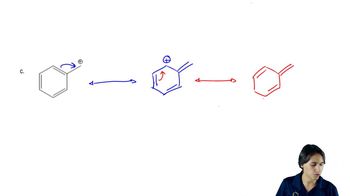
Drawing Resonance Structures

Aromaticity

Aromaticity refers to the enhanced stability of certain cyclic compounds due to the delocalization of π electrons across the ring. For phenolate, the aromatic ring maintains its stability even when a negative charge is present, allowing for resonance contributors that involve the movement of electrons while preserving the aromatic character of the benzene ring.
추천 영상:
08:19
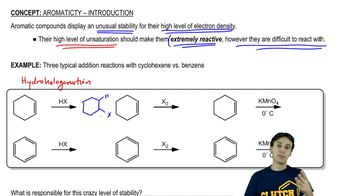
Intro to Aromaticity

Phenolate Ion

The phenolate ion is the conjugate base of phenol, formed when phenol loses a proton (H+). This ion features a negative charge on the oxygen atom, which can be delocalized into the aromatic ring through resonance. Understanding the structure and behavior of the phenolate ion is crucial for predicting its reactivity and interactions in organic reactions.
추천 영상:
02:27
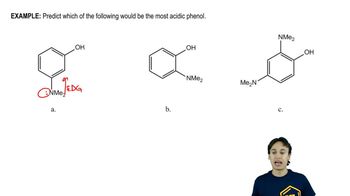
Identify the most acidic phenol