Ch. 8 - Delocalized Electrons: Their Effect on Stability, pKa, and the Products of a Reaction • Aromaticity and Electronic Effects: An Introduction to the Reactions of Benzene
Bruice - Organic Chemistry 8th Edition
Bruice8th EditionOrganic ChemistryISBN: 9780135213711당신이 사용하는 게 아니라요?교과서 변경
8장, 문제 94e,f

e. Which has a greater Ka: cyclohexanol or phenol?
f. Which is a stronger acid: cyclohexanol or phenol?

검증된 단계별 안내
1
Step 1: Understand the concept of Ka and acid strength. Ka, the acid dissociation constant, measures the extent to which an acid dissociates in water. A higher Ka value indicates a stronger acid because it dissociates more readily to release H⁺ ions.
Step 2: Analyze the chemical structures of cyclohexanol and phenol. Cyclohexanol is an alcohol with a hydroxyl group (-OH) attached to a cyclohexane ring, while phenol has a hydroxyl group attached to a benzene ring.
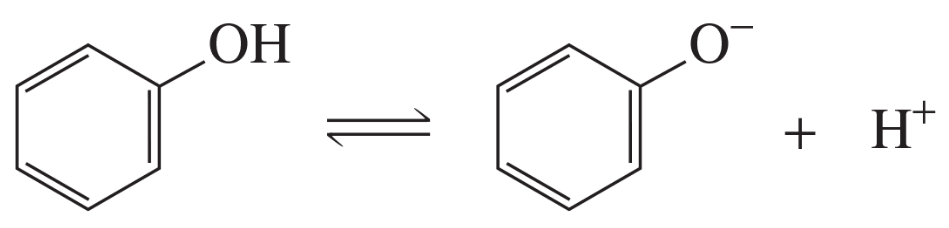
Step 3: Consider the resonance stabilization of the conjugate base. Phenol's conjugate base (phenoxide ion) is stabilized by resonance because the negative charge on the oxygen can delocalize into the aromatic ring. Cyclohexanol's conjugate base lacks this resonance stabilization, making it less stable.
Step 4: Compare the Ka values. From the image, cyclohexanol has a Ka of 1 × 10⁻¹⁶, which is extremely small, indicating it is a very weak acid. Phenol, although its Ka is not explicitly provided in the image, is known to have a significantly higher Ka due to the resonance stabilization of its conjugate base.
Step 5: Conclude the comparison. Phenol has a greater Ka and is a stronger acid than cyclohexanol because its conjugate base is stabilized by resonance, allowing it to dissociate more readily in water.

비슷한 문제에 대한 검증된 영상 답변:

이 영상 해법은 위 문제에 도움이 된다고 튜터들이 추천한 것입니다.
영상 길이:
5m

주요 개념

질문에 올바르게 답하기 위해 반드시 이해해야 하는 핵심 개념들은 다음과 같습니다.

Acidity and pKa

Acidity in organic chemistry is often measured by the acid dissociation constant (Ka), which quantifies the strength of an acid in solution. A higher Ka value indicates a stronger acid, meaning it dissociates more completely in water. The pKa, which is the negative logarithm of Ka, is commonly used to compare acid strengths; lower pKa values correspond to stronger acids.
추천 영상:
07:45
Identifying pKa values

Resonance Stabilization

Resonance stabilization occurs when a molecule can be represented by multiple valid Lewis structures, allowing for the delocalization of electrons. In the case of phenol, the negative charge on the phenoxide ion (the conjugate base) can be delocalized over the aromatic ring, enhancing its stability compared to cyclohexanol, which lacks such resonance stabilization.
추천 영상:
03:43
The radical stability trend.

Comparative Acid Strength

To determine which compound is a stronger acid, one must compare their ability to donate protons (H+). Phenol is generally a stronger acid than cyclohexanol due to the resonance stabilization of its conjugate base, phenoxide. This stabilization lowers the energy of the conjugate base, making it more favorable for phenol to lose a proton compared to cyclohexanol.
추천 영상:
02:41
Comparing hydrocarbon acidity