Ch.10 - Structure and Synthesis of Alcohols
Wade - Organic Chemistry 9th Edition
Wade9th EditionOrganic ChemistryISBN: 9780135213728당신이 사용하는 게 아니라요?교과서 변경
10장, 문제 29

Authentic skunk spray has become valuable for use in scent-masking products. Show how you would synthesize the major component of skunk spray (3-methylbutane-1-thiol and but-2-ene-1-thiol) from any of the readily available butene or from buta-1,3-diene.

검증된 단계별 안내
1
Step 1: Begin with buta-1,3-diene as the starting material. Perform a hydroboration reaction using diborane (B2H6) followed by oxidation with hydrogen peroxide (H2O2) in a basic solution (NaOH). This will yield 3-methylbutan-1-ol as the intermediate.
Step 2: Convert the alcohol group (-OH) in 3-methylbutan-1-ol into a good leaving group by reacting it with thionyl chloride (SOCl2) or tosyl chloride (TsCl) in the presence of pyridine. This will form 3-methylbutyl chloride or a tosylate derivative.
Step 3: Perform a nucleophilic substitution reaction (SN2 mechanism) using sodium hydrosulfide (NaSH) as the nucleophile. This will replace the leaving group with a thiol (-SH) group, forming 3-methylbutane-1-thiol.
Step 4: Purify the product using distillation or recrystallization techniques to isolate 3-methylbutane-1-thiol.
Step 5: Confirm the structure of the synthesized compound using spectroscopic methods such as NMR (nuclear magnetic resonance) and IR (infrared spectroscopy) to ensure the presence of the thiol group and the correct carbon skeleton.

비슷한 문제에 대한 검증된 영상 답변:

이 영상 해법은 위 문제에 도움이 된다고 튜터들이 추천한 것입니다.
영상 길이:
2m

주요 개념

질문에 올바르게 답하기 위해 반드시 이해해야 하는 핵심 개념들은 다음과 같습니다.

Alkene Reactions

Alkenes are hydrocarbons that contain at least one carbon-carbon double bond. They are reactive and can undergo various reactions, such as electrophilic addition, where reagents add across the double bond. Understanding how to manipulate alkenes is crucial for synthesizing compounds like 3-methylbutane-1-thiol from butene or buta-1,3-diene.
추천 영상:
가이드 코스
2:09
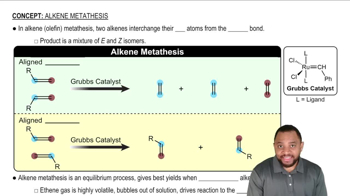
Alkene Metathesis Concept 1

Nucleophilic Substitution

Nucleophilic substitution is a fundamental reaction mechanism in organic chemistry where a nucleophile replaces a leaving group in a molecule. In the synthesis of thiols, such as 3-methylbutane-1-thiol, this mechanism can be employed to introduce a thiol group (-SH) into an organic compound, often using alkyl halides as starting materials.
추천 영상:
01:47
Nucleophiles and Electrophiles can react in Substitution Reactions.

Functional Group Transformation

Functional group transformation involves converting one functional group into another through chemical reactions. In the context of synthesizing 3-methylbutane-1-thiol, transforming alkenes or alkyl halides into thiols is essential. This concept is key to understanding how to manipulate molecular structures to achieve desired products in organic synthesis.
추천 영상:
02:36
Identifying Functional Groups