


Authentic skunk spray has become valuable for use in scent-masking products. Show how you would synthesize the major component of skunk spray (3-methylbutane-1-thiol and but-2-ene-1-thiol) from any of the readily available butene or from buta-1,3-diene.
Ch.10 - Structure and Synthesis of Alcohols
10장, 문제 30f,g
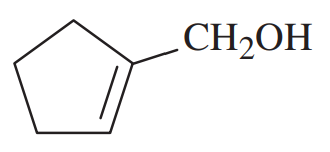
Give a systematic (IUPAC) name for each alcohol. Classify each as primary, secondary, or tertiary.
(f) 
(g) 
검증된 단계별 안내1
Step 1: Identify the longest carbon chain that contains the hydroxyl group (OH) in each structure. This will be the parent chain for naming the alcohol.
Step 2: Number the carbon atoms in the parent chain starting from the end nearest to the hydroxyl group. This ensures the lowest possible number for the OH group.
Step 3: For the first structure, observe the branching and identify any substituents attached to the main chain. The presence of a methyl group on the second carbon should be noted.
Step 4: For the second structure, recognize the cyclopentane ring and the hydroxymethyl group attached to it. The ring itself is the parent structure.
Step 5: Classify each alcohol based on the carbon atom to which the OH group is attached: primary (1°) if attached to a carbon with one other carbon, secondary (2°) if attached to a carbon with two other carbons, and tertiary (3°) if attached to a carbon with three other carbons.

비슷한 문제에 대한 검증된 영상 답변:
이 영상 해법은 위 문제에 도움이 된다고 튜터들이 추천한 것입니다.
영상 길이:
14m도움이 되었나요?
주요 개념
질문에 올바르게 답하기 위해 반드시 이해해야 하는 핵심 개념들은 다음과 같습니다.
IUPAC Nomenclature
IUPAC nomenclature is a systematic method for naming organic chemical compounds. It provides a set of rules to derive the names based on the structure of the molecule, including the longest carbon chain, functional groups, and their positions. Understanding these rules is essential for accurately naming alcohols and other organic compounds.
추천 영상:
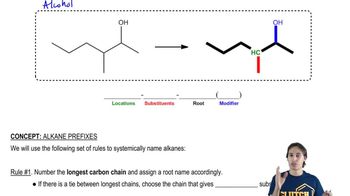
The different parts of an IUPAC name
Classification of Alcohols
Alcohols are classified based on the number of carbon atoms bonded to the carbon atom that carries the hydroxyl (-OH) group. Primary alcohols have one carbon attached to the hydroxyl-bearing carbon, secondary alcohols have two, and tertiary alcohols have three. This classification affects the physical and chemical properties of the alcohols.
추천 영상:
Structural Classification
Functional Groups
Functional groups are specific groups of atoms within molecules that are responsible for the characteristic chemical reactions of those molecules. In the case of alcohols, the hydroxyl group (-OH) is the functional group that defines their properties and reactivity. Recognizing functional groups is crucial for understanding the behavior of organic compounds.
추천 영상:
Identifying Functional Groups
관련 실천
교과서 질문
1241
views
교과서 질문
Draw the structures of the following compounds. (Includes both new and old names.)
(a) triphenylmethanol
(b) 4-(chloromethyl)heptan-3-ol
(c) 2-cyclohexen-1-ol
1593
views
교과서 질문
Give systematic (IUPAC) names for the following diols and phenols.
(a)
(b)
1516
views
교과서 질문
Give IUPAC names for the following compounds.
1759
views
교과서 질문
Arrange the following compounds in order of decreasing acidity.
CH3COOH, CH3OH, CH3CH3, CH3SO3H, CH3NH2, CH3SH, CH3C≡CH
1124
views
교과서 질문
Draw the structures of the following compounds. (Includes both new and old names.)
(d) 3-cyclopentylhexan-3-ol
(e) meso-2,4-pentanediol
1146
views
