

Ch.10 - Structure and Synthesis of Alcohols
Wade - Organic Chemistry 9th Edition
Wade9th EditionOrganic ChemistryISBN: 9780135213728당신이 사용하는 게 아니라요?교과서 변경
10장, 문제 32a,b,c

Draw the structures of the following compounds. (Includes both new and old names.)
(a) triphenylmethanol
(b) 4-(chloromethyl)heptan-3-ol
(c) 2-cyclohexen-1-ol

검증된 단계별 안내
1
To draw triphenylmethanol, start by identifying the core structure: a central carbon atom bonded to three phenyl groups (C6H5) and one hydroxyl group (OH). Arrange the phenyl groups around the central carbon in a tetrahedral geometry, and attach the hydroxyl group to the central carbon.
For 4-(chloromethyl)heptan-3-ol, begin by drawing the heptane backbone, which consists of a seven-carbon chain. Number the carbon atoms from one end to the other. At carbon 3, attach a hydroxyl group (OH). At carbon 4, attach a chloromethyl group (CH2Cl).
To draw 2-cyclohexen-1-ol, start with a cyclohexene ring, which is a six-membered carbon ring with one double bond. Place the double bond between carbon 1 and carbon 2. Attach a hydroxyl group (OH) to carbon 1.
Ensure that all hydrogen atoms are added to satisfy the valency of each carbon atom in the structures. For example, each carbon in the phenyl groups of triphenylmethanol should have one hydrogen, except for the central carbon, which is fully substituted.
Double-check the structures for any stereochemistry or geometric isomerism, especially in compounds with double bonds or chiral centers, to ensure the correct spatial arrangement of atoms.

비슷한 문제에 대한 검증된 영상 답변:

이 영상 해법은 위 문제에 도움이 된다고 튜터들이 추천한 것입니다.
영상 길이:
5m

주요 개념

질문에 올바르게 답하기 위해 반드시 이해해야 하는 핵심 개념들은 다음과 같습니다.

IUPAC Nomenclature

IUPAC nomenclature is a systematic method of naming organic chemical compounds as recommended by the International Union of Pure and Applied Chemistry. It provides a standardized way to name compounds based on their structure, ensuring clarity and consistency. Understanding IUPAC rules is essential for interpreting chemical names and drawing corresponding structures.
추천 영상:
03:43
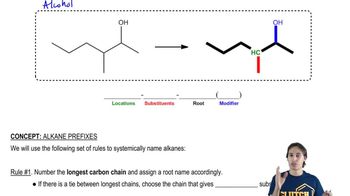
The different parts of an IUPAC name

Functional Groups

Functional groups are specific groups of atoms within molecules that are responsible for the characteristic chemical reactions of those molecules. Recognizing functional groups such as alcohols, alkenes, and halides is crucial for identifying the chemical behavior and structure of organic compounds. In the given question, alcohol (-OH) and halide (Cl) groups are key to drawing the structures.
추천 영상:
02:36
Identifying Functional Groups

Structural Isomerism

Structural isomerism occurs when compounds have the same molecular formula but different structural arrangements of atoms. Understanding structural isomerism is important for accurately drawing organic compounds, as it involves recognizing different possible configurations, such as chain branching or ring formation, which can affect the compound's properties and name.
추천 영상:
06:47
Monosaccharides - D and L Isomerism