Ch.10 - Structure and Synthesis of Alcohols
Wade - Organic Chemistry 9th Edition
Wade9th EditionOrganic ChemistryISBN: 9780135213728당신이 사용하는 게 아니라요?교과서 변경
10장, 문제 57e,f

Show how this 1° alcohol can be made from the following:
Structural formula of a 1° alcohol with a hydroxyl group and a five-membered carbon ring.
(e) an alkene
(f) ethylene oxide

검증된 단계별 안내
1
Step 1: To synthesize the given 1° alcohol from an alkene, identify the corresponding alkene structure. The alcohol shown has a hydroxyl group (-OH) attached to a primary carbon. The alkene precursor would be cyclopentyl ethene (cyclopentyl group attached to a double bond).
Step 2: Perform hydroboration-oxidation on the alkene. This reaction involves two steps: (a) Add BH₃ (borane) or a borane derivative to the alkene to form an organoborane intermediate. (b) Oxidize the organoborane intermediate using H₂O₂ (hydrogen peroxide) in a basic solution (NaOH). This results in anti-Markovnikov addition of water, forming the 1° alcohol.
Step 3: To synthesize the given 1° alcohol from ethylene oxide, identify the nucleophile that can attack the ethylene oxide ring. The nucleophile in this case would be cyclopentylmethyl anion (generated from cyclopentylmethyl bromide using a strong base like NaH).
Step 4: Perform a ring-opening reaction of ethylene oxide. The nucleophile attacks the less hindered carbon of the ethylene oxide ring, leading to the formation of a primary alcohol. This reaction is typically carried out in an aqueous or alcohol solvent.
Step 5: After the ring-opening reaction, ensure the product matches the structure of the desired 1° alcohol. Verify that the hydroxyl group is attached to the primary carbon and the cyclopentyl group is intact.

비슷한 문제에 대한 검증된 영상 답변:

이 영상 해법은 위 문제에 도움이 된다고 튜터들이 추천한 것입니다.
영상 길이:
4m

주요 개념

질문에 올바르게 답하기 위해 반드시 이해해야 하는 핵심 개념들은 다음과 같습니다.

Alcohol Synthesis from Alkenes

The conversion of alkenes to alcohols typically involves hydration reactions. This can be achieved through acid-catalyzed hydration, where water adds across the double bond of the alkene, or through hydroboration-oxidation, which provides anti-Markovnikov addition. Understanding the mechanism and regioselectivity of these reactions is crucial for synthesizing the desired primary alcohol.
추천 영상:
01:44
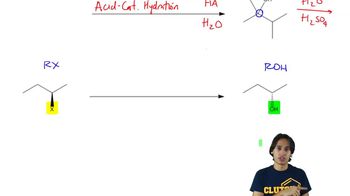
Forming alcohols through SN2 reactions.

Ethylene Oxide as a Reactant

Ethylene oxide is a cyclic ether that can be used to produce alcohols through ring-opening reactions. When reacted with nucleophiles, such as alcohols or water, the strained ring opens, leading to the formation of a primary alcohol. This reaction is significant in organic synthesis, particularly for creating alcohols with specific stereochemistry.
추천 영상:
가이드 코스
1:21
Pyruvate Oxidation Example 1

Regioselectivity in Organic Reactions

Regioselectivity refers to the preference of a chemical reaction to yield one structural isomer over others when multiple possibilities exist. In the context of alcohol synthesis, understanding regioselectivity is essential to predict the major product formed from alkenes or cyclic ethers, ensuring the correct primary alcohol is synthesized based on the reaction conditions and reagents used.
추천 영상:
02:17
Identifying organic molecules