뒤로
뒤로
문제 40c
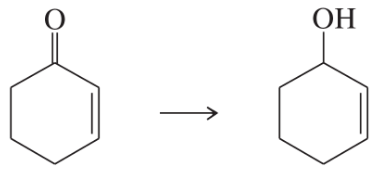
Show how you would accomplish the following transformations. You may use any additional reagents you need.
(c)
문제 40d
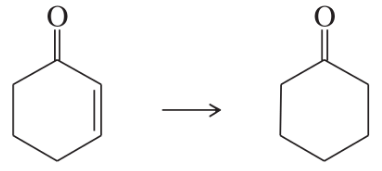
Show how you would accomplish the following transformations. You may use any additional reagents you need.
(d)
문제 41a
Show how you would synthesize the following:
a. 2-phenylethanol by the addition of formaldehyde to a suitable Grignard reagent
문제 41c
Show how you would synthesize the following:
c. cyclohexylmethanol from an alkyl halide using an SN2 reaction
문제 41e
Show how you would synthesize the following:
e. cis-pent-2-en-1-thiol from a suitable alkenyl halide
문제 41f
Show how you would synthesize the following:
f. 2,5-dimethylhexane from a four-carbon alkyl halide
문제 42d
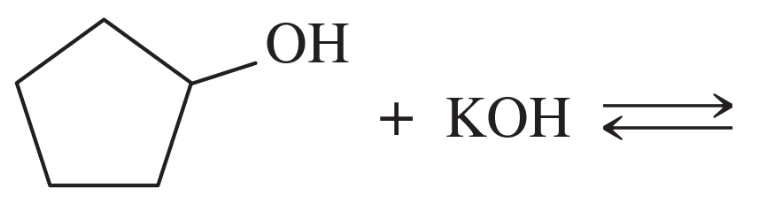
Complete the following acid–base reactions. In each case, indicate whether the equilibrium favors the reactants or the products, and explain your reasoning.
(d)
문제 42e
Complete the following acid–base reactions. In each case, indicate whether the equilibrium favors the reactants or the products, and explain your reasoning.
(e) (CH3)3C–O– + CH3CH2OH ⇌
문제 42f
Complete the following acid–base reactions. In each case, indicate whether the equilibrium favors the reactants or the products, and explain your reasoning.
(f) (CH3)3C–O– + H2O ⇌
문제 42g
Complete the following acid–base reactions. In each case, indicate whether the equilibrium favors the reactants or the products, and explain your reasoning.
(g) KOH + CH3CH2OH ⇌
문제 43a
Suggest carbonyl compounds and reducing agents that might be used to form the following alcohols.
(a) octan-1-ol
문제 43b
Suggest carbonyl compounds and reducing agents that might be used to form the following alcohols.
(b) 1-cyclohexylpropan-1-ol
문제 43c,d
Suggest carbonyl compounds and reducing agents that might be used to form the following alcohols.
(c) 1-phenylbutan-1-ol
(d)
문제 43e,f
Suggest carbonyl compounds and reducing agents that might be used to form the following alcohols.
(e)
(f)
문제 44a
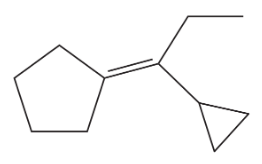
Show how you would synthesize the following compounds from any starting materials containing no more than six carbon atoms.
(a)
문제 44b
Show how you would synthesize the following compounds from any starting materials containing no more than six carbon atoms.
(b)
문제 45
Geminal diols, or 1,1-diols, are usually unstable, spontaneously losing water to give carbonyl compounds. Therefore, geminal diols are regarded as hydrated forms of ketones and aldehydes. Propose a mechanism for the acid-catalyzed loss of water from propane-2,2-diol to give acetone.
문제 46a
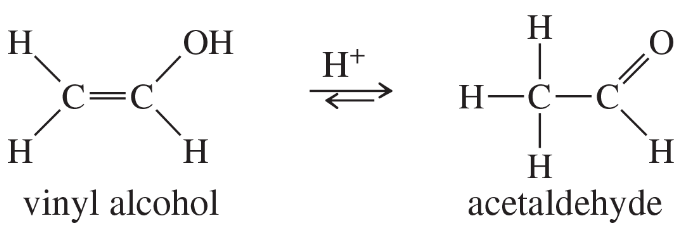
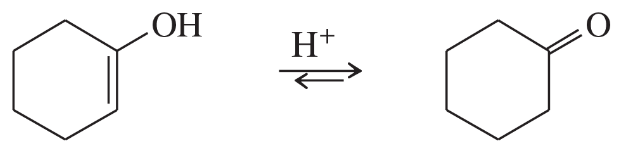
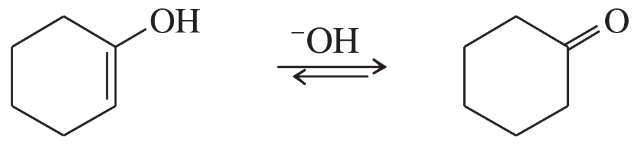
Vinyl alcohols are generally unstable, quickly isomerizing to carbonyl compounds. Propose mechanisms for the following isomerizations.
(a)
문제 46b
Vinyl alcohols are generally unstable, quickly isomerizing to carbonyl compounds. Propose mechanisms for the following isomerizations.
(b)
문제 46c
Vinyl alcohols are generally unstable, quickly isomerizing to carbonyl compounds. Propose mechanisms for the following isomerizations.
(c)
문제 47
Compound A (C7H11Br) is treated with magnesium in ether to give B (C7H11MgBr), which reacts violently with D2O to give 1-methylcyclohexene with a deuterium atom on the methyl group (C). Reaction of B with acetone (CH3COCH3) followed by hydrolysis gives D (C10H18O). Heating D with concentrated H2SO4 gives E (C10H16), which decolorizes two equivalents of Br2 to give F (C10H16Br4). E undergoes hydrogenation with excess H2 and a Pt catalyst to give isobutylcyclohexane. Determine the structures of compounds A through F, and show your reasoning throughout.
문제 48
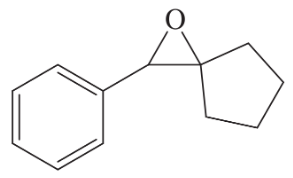
Grignard reagents react slowly with oxetane to produce primary alcohols. Propose a mechanism for this reaction, and suggest why oxetane reacts with Grignard reagents even though most ethers do not.
문제 49
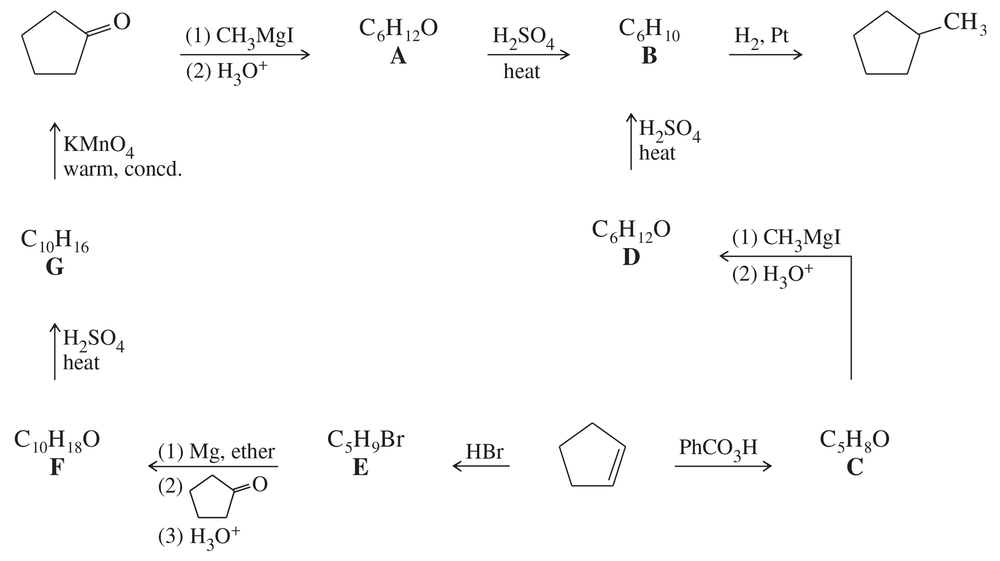
Determine the structures of compounds A through G, including stereochemistry where appropriate.
문제 50
Many hunting dogs enjoy standing nose-to-nose with a skunk while barking furiously, oblivious to the skunk spray directed toward them. One moderately effective way of lessening the amount of odor is to wash the dog in a bath containing dilute hydrogen peroxide, sodium bicarbonate, and some mild dish detergent. Use chemical reactions to describe how this mixture helps to remove the skunk spray from the dog. The two major components of skunk oil are 3-methylbutane-1-thiol and but-2-ene-1-thiol.
문제 51a-d
Propose structures for intermediates and products (A) through (D).
문제 51a-d
Propose structures for intermediates and products (A) through (D)
문제 51f,g
Propose structures for intermediates and products (F) through (G)
문제 52a
Devise a synthesis for each compound, starting with methylenecyclohexane and any other reagents you need.
a. 1-methylcyclohexanol
문제 52b
Devise a synthesis for each compound, starting with methylenecyclohexane and any other reagents you need.
b. cyclohexylmethanol
문제 52c
Devise a synthesis for each compound, starting with methylenecyclohexane and any other reagents you need.
c. 1-(hydroxymethyl)cyclohexanol