뒤로
뒤로
문제 52d
Devise a synthesis for each compound, starting with methylenecyclohexane and any other reagents you need.
d. trans-2-methylcyclohexanol
문제 52f
Devise a synthesis for each compound, starting with methylenecyclohexane and any other reagents you need.
f. 1-(phenylmethyl)cyclohexanol
문제 53a
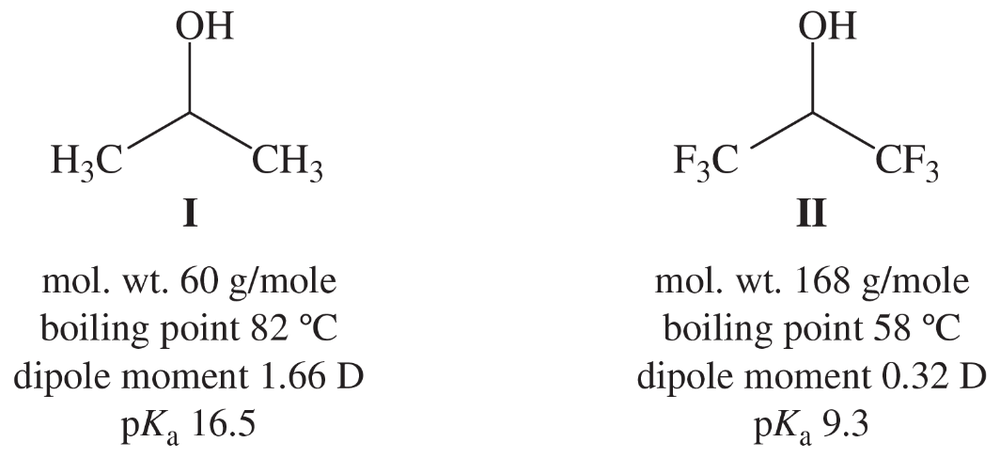
Compare the properties of propan-2-ol (I) and the hexafluoro analog (II).
(a) Compound II has almost triple the molecular weight of I, but II has a lower boiling point. Explain.
문제 54a
Compounds containing deuterium (D = 2H) are useful for kinetic studies and metabolic studies with new pharmaceuticals. One way to introduce deuterium is by using the reagent LiAlD4, equivalent in reactivity to LiAlH4. Show how to make these deuterium-labeled compounds, using LiAlD4 and D2O as your sources of deuterium, and any non-deuterated starting materials you wish.
a. CH3CHDOH
문제 54b
Compounds containing deuterium (D = 2H) are useful for kinetic studies and metabolic studies with new pharmaceuticals. One way to introduce deuterium is by using the reagent LiAlD4, equivalent in reactivity to LiAlH4. Show how to make these deuterium-labeled compounds, using LiAlD4 and D2O as your sources of deuterium, and any non-deuterated starting materials you wish.
(b) CH3CD2OH
문제 54c
Compounds containing deuterium (D = 2H) are useful for kinetic studies and metabolic studies with new pharmaceuticals. One way to introduce deuterium is by using the reagent LiAlD4, equivalent in reactivity to LiAlH4. Show how to make these deuterium-labeled compounds, using LiAlD4 and D2O as your sources of deuterium, and any non-deuterated starting materials you wish.
(c) CH3CD2OD
문제 55a
Show how to make these deuterium-labeled compounds, using CD3MgBr and D2O as your sources of deuterium, and any non-deuterated starting materials you wish.
a. CH3CH(OD)CD3
문제 55b
Show how to make these deuterium-labeled compounds, using CD3MgBr and D2O as your sources of deuterium, and any non-deuterated starting materials you wish.
b. CH3C(OH)(CD3)2
문제 55c
Show how to make these deuterium-labeled compounds, using CD3MgBr and D2O as your sources of deuterium, and any non-deuterated starting materials you wish.
c. CD3CH2CH2OH
문제 55d
Show how to make these deuterium-labeled compounds, using CD3MgBr and D2O as your sources of deuterium, and any non-deuterated starting materials you wish.
d. Ph(CD3)2COD
문제 56a
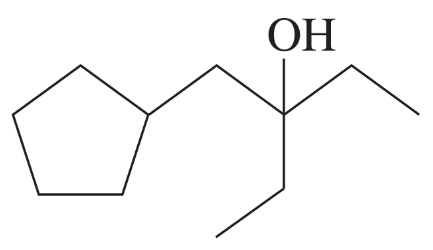
Often, compounds can be synthesized by more than one method. Show how this 3° alcohol can be made from the following:
(a) two different ketones
문제 56b
Often, compounds can be synthesized by more than one method. Show how this 3° alcohol can be made from the following:
(b) two different alkenes
문제 56c
Often, compounds can be synthesized by more than one method. Show how this 3° alcohol can be made from the following:
(c) an ester
문제 56d
Often, compounds can be synthesized by more than one method. Show how this 3° alcohol can be made from the following:
(d) a 3° alkyl bromide
문제 57a
Show how this 1° alcohol can be made from the following:
(a) a 1° alkyl bromide
문제 57b
Show how this 1° alcohol can be made from the following:
(b) formaldehyde
문제 57c,d
Show how this 1° alcohol can be made from the following:
(c) a 7-carbon aldehyde
(d) a carboxylic acid
문제 57e,f
Show how this 1° alcohol can be made from the following:
(e) an alkene
(f) ethylene oxide
문제 58a
For each synthesis, start with bromocyclohexane and predict the products. Assume that an excess of each reactant is added so that all possible reactions that can happen will happen.
(a)
문제 58b
For each synthesis, start with bromocyclohexane and predict the products. Assume that an excess of each reactant is added so that all possible reactions that can happen will happen.
(b)
문제 58c
For each synthesis, start with bromocyclohexane and predict the products. Assume that an excess of each reactant is added so that all possible reactions that can happen will happen.
(c)
문제 60a,b
Problem 8-54 describes a new method to perform ozonolysis reactions that used pyridine (py) to generate the final aldehydes and ketones in a non-aqueous reaction medium. In a subsequent publication (J. Org. Chem., 2013, 78, 42), Professor Dussault (U. of Nebraska at Lincoln) described a “tandem” process in which two reactions are performed sequentially without having to isolate the intermediate aldehyde or ketone. Show the final product from each sequence. (Hint: The isolated products were from the larger part of the structure. Ignore stereochemistry.)
(a)
(b)
문제 60c,d
Problem 8-54 describes a new method to perform ozonolysis reactions that used pyridine (py) to generate the final aldehydes and ketones in a non-aqueous reaction medium. In a subsequent publication (J. Org. Chem., 2013, 78, 42), Professor Dussault (U. of Nebraska at Lincoln) described a “tandem” process in which two reactions are performed sequentially without having to isolate the intermediate aldehyde or ketone. Show the final product from each sequence. (Hint: The isolated products were from the larger part of the structure. Ignore stereochemistry.)
(c)
(d)