Ch.11 - Reactions of Alcohols
Wade - Organic Chemistry 9th Edition
Wade9th EditionOrganic ChemistryISBN: 9780135213728당신이 사용하는 게 아니라요?교과서 변경
11장, 문제 28

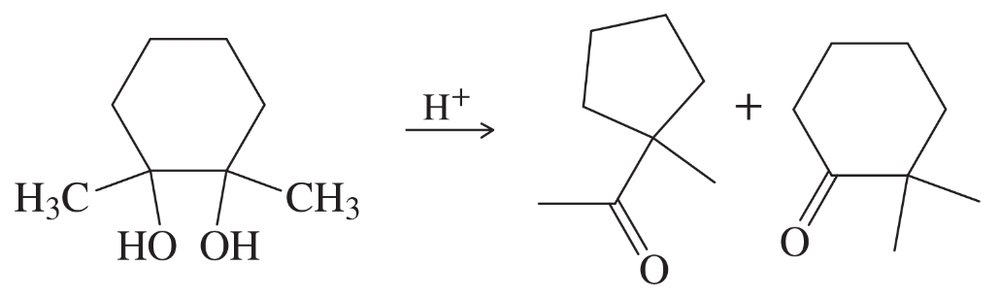
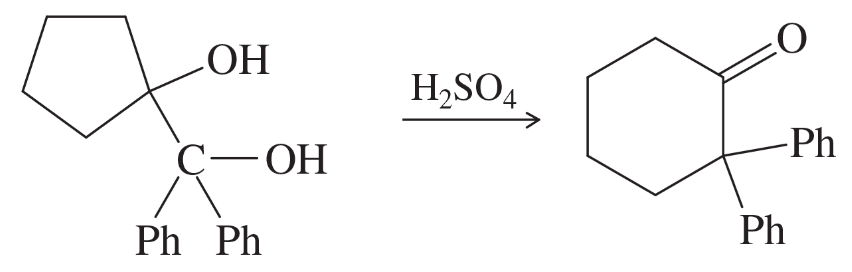
Propose a mechanism for each reaction.
(a)
(b)

검증된 단계별 안내
1
Step 1 (Reaction A): Protonation of one of the hydroxyl groups occurs in the presence of H⁺, making it a better leaving group. This forms a carbocation intermediate.
Step 2 (Reaction A): The carbocation undergoes rearrangement to stabilize itself, potentially forming a more stable tertiary carbocation.
Step 3 (Reaction A): The remaining hydroxyl group acts as a nucleophile and attacks the carbocation, leading to the formation of a cyclic intermediate.
Step 4 (Reaction A): Deprotonation of the cyclic intermediate occurs, resulting in the formation of the ketone product.
Step 5 (Reaction B): In the presence of H₂SO₄, the hydroxyl group is protonated, making it a better leaving group. This leads to the formation of a carbocation intermediate, which undergoes rearrangement and nucleophilic attack by the phenyl groups to form the ketone product.

비슷한 문제에 대한 검증된 영상 답변:

이 영상 해법은 위 문제에 도움이 된다고 튜터들이 추천한 것입니다.
영상 길이:
17m
도움이 되었나요?

주요 개념

질문에 올바르게 답하기 위해 반드시 이해해야 하는 핵심 개념들은 다음과 같습니다.

Protonation

Protonation is the addition of a proton (H+) to a molecule, which can enhance its reactivity. In the context of organic reactions, protonation often occurs at sites of high electron density, such as alcohols or double bonds, making them more susceptible to nucleophilic attack or facilitating bond rearrangements.
추천 영상:
03:
Proton Splitting

Nucleophilic Attack

Nucleophilic attack refers to the process where a nucleophile, an electron-rich species, attacks an electrophile, an electron-deficient species. This is a fundamental step in many organic reactions, leading to the formation of new bonds. Understanding the nature of nucleophiles and electrophiles is crucial for predicting reaction outcomes.
추천 영상:
08:27
Nucleophilic Addition

Rearrangement Reactions

Rearrangement reactions involve the reorganization of atoms within a molecule, often resulting in structural isomers. These reactions can be driven by the stability of intermediates formed during the process, such as carbocations. Recognizing the conditions that favor rearrangements is essential for proposing accurate reaction mechanisms.
추천 영상:
06:28
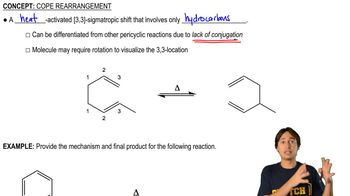
Definition of Cope Rearrangement