Ch.11 - Reactions of Alcohols
Wade - Organic Chemistry 9th Edition
Wade9th EditionOrganic ChemistryISBN: 9780135213728당신이 사용하는 게 아니라요?교과서 변경
11장, 문제 29

The following reaction involves a starting material with a double bond and a hydroxy group, yet its mechanism resembles a pinacol rearrangement. Propose a mechanism, and point out the part of your mechanism that resembles a pinacol rearrangement.
Chemical reaction showing a hydroxy group and double bond converting to a cyclic compound with a carbonyl group.

검증된 단계별 안내
1
Step 1: Protonation of the hydroxy group - The reaction begins with the protonation of the hydroxy (-OH) group by the sulfuric acid (H₂SO₄), which acts as a strong acid. This step increases the electrophilicity of the oxygen atom and prepares the molecule for the subsequent rearrangement.
Step 2: Formation of a carbocation - After protonation, the water molecule (H₂O) leaves, generating a carbocation at the carbon attached to the hydroxy group. This carbocation is stabilized by the adjacent cyclopropyl group and the double bond.
Step 3: Rearrangement resembling pinacol rearrangement - The cyclopropyl group undergoes a ring-opening process, which resembles the pinacol rearrangement. This step involves a 1,2-shift of the cyclopropyl group to stabilize the carbocation further. The rearrangement leads to the formation of a new carbocation intermediate.
Step 4: Hydride shift and formation of the ketone - A hydride shift occurs from the adjacent carbon atom to stabilize the carbocation. This results in the formation of a ketone functional group, completing the rearrangement process.
Step 5: Final product formation - The final product is a cyclobutanone derivative, where the double bond has been rearranged and the hydroxy group has been converted into a ketone. The mechanism's resemblance to a pinacol rearrangement lies in the 1,2-shift and carbocation stabilization steps.

비슷한 문제에 대한 검증된 영상 답변:

이 영상 해법은 위 문제에 도움이 된다고 튜터들이 추천한 것입니다.
영상 길이:
6m
도움이 되었나요?

주요 개념

질문에 올바르게 답하기 위해 반드시 이해해야 하는 핵심 개념들은 다음과 같습니다.

Pinacol Rearrangement

The pinacol rearrangement is a chemical reaction where a pinacol (a compound with two hydroxyl groups on adjacent carbons) undergoes acid-catalyzed rearrangement to form a ketone or aldehyde. This process involves the migration of a group (usually an alkyl group) and the formation of a carbocation intermediate, which is key to understanding how the structure changes during the reaction.
추천 영상:
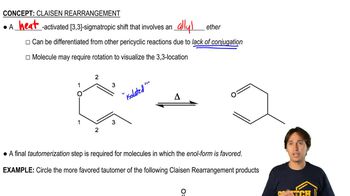
06:08
Definition of Claisen Rearrangement

Carbocation Stability

Carbocations are positively charged carbon species that play a crucial role in many organic reactions, including rearrangements. The stability of a carbocation is influenced by its degree (primary, secondary, tertiary) and the presence of electron-donating groups. Understanding carbocation stability helps predict the favored pathways and products in reactions resembling the pinacol rearrangement.
추천 영상:
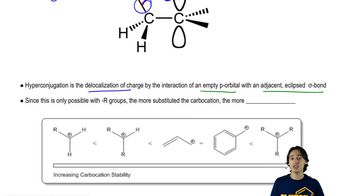
05:58
Determining Carbocation Stability

Mechanistic Pathways

Mechanistic pathways describe the step-by-step sequence of elementary reactions that occur during a chemical transformation. In the context of the question, identifying the mechanistic steps that resemble a pinacol rearrangement involves recognizing the formation of a carbocation and subsequent rearrangement, which is essential for proposing a complete and accurate reaction mechanism.
추천 영상:
가이드 코스
2:13
Energy Production In Biochemical Pathways Concept 1