Ch. 13 - Nuclear Magnetic Resonance Spectroscopy
Wade - Organic Chemistry 9th Edition
Wade9th EditionOrganic ChemistryISBN: 9780135213728당신이 사용하는 게 아니라요?교과서 변경
13장, 문제 24b

Five proton NMR spectra are given here, together with molecular formulas. In each case, propose a structure that is consistent with the spectrum.
(b) <IMAGE>

검증된 단계별 안내
1
Analyze the molecular formula C8H8O provided in the problem. This indicates the molecule contains 8 carbons, 8 hydrogens, and 1 oxygen. The degree of unsaturation can be calculated using the formula: Degree of Unsaturation = (2C + 2 - H)/2. For C8H8O, the degree of unsaturation is (2(8) + 2 - 8)/2 = 5, suggesting the presence of rings and/or double bonds.
Examine the proton NMR spectrum. The peaks near δ = 7-8 ppm suggest the presence of aromatic protons, which are characteristic of benzene rings. This aligns with the degree of unsaturation calculation, indicating an aromatic ring.
The peak near δ = 2.8-3.1 ppm is a multiplet, which suggests the presence of protons adjacent to a functional group, such as a carbonyl group or an aromatic ring. This region is typical for benzylic protons (protons attached to a carbon adjacent to an aromatic ring).
The peak near δ = 9-10 ppm is a singlet, which is characteristic of an aldehyde proton (-CHO group). This strongly suggests the molecule contains an aldehyde functional group.
Combine the observations: The molecule likely contains a benzene ring (aromatic protons), a benzylic group (multiplet near δ = 2.8-3.1 ppm), and an aldehyde group (singlet near δ = 9-10 ppm). Based on the molecular formula and NMR data, propose a structure consistent with these features, such as benzaldehyde (C6H5CHO).

비슷한 문제에 대한 검증된 영상 답변:

이 영상 해법은 위 문제에 도움이 된다고 튜터들이 추천한 것입니다.
영상 길이:
5m
도움이 되었나요?

주요 개념

질문에 올바르게 답하기 위해 반드시 이해해야 하는 핵심 개념들은 다음과 같습니다.

Proton NMR Spectroscopy

Proton Nuclear Magnetic Resonance (NMR) spectroscopy is a powerful analytical technique used to determine the structure of organic compounds. It provides information about the number of hydrogen atoms in a molecule and their environment, allowing chemists to infer connectivity and functional groups. The chemical shifts, splitting patterns, and integration of peaks in the spectrum are key to interpreting the molecular structure.
추천 영상:
10:06
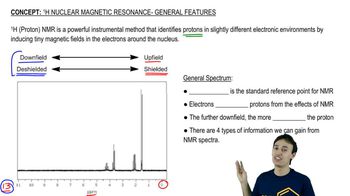
General NMR Features

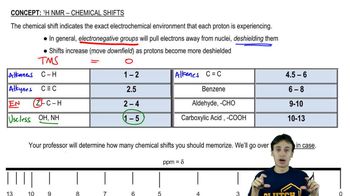
Chemical Shift

Chemical shift refers to the resonance frequency of a nucleus relative to a standard in a magnetic field, typically measured in parts per million (ppm). In proton NMR, different chemical environments of hydrogen atoms lead to distinct chemical shifts, which help identify functional groups and the electronic environment surrounding the protons. Understanding chemical shifts is crucial for deducing the structure of the compound from the NMR spectrum.
추천 영상:
11:44
1H NMR Chemical Shifts

Spin-Spin Coupling

Spin-spin coupling, or J-coupling, occurs when protons that are close to each other influence each other's magnetic environments, resulting in splitting of NMR signals. This phenomenon provides information about the number of neighboring protons and their arrangement, which is essential for constructing the molecular structure. Analyzing the splitting patterns allows chemists to deduce connectivity and confirm the proposed structure.
추천 영상:
02:54
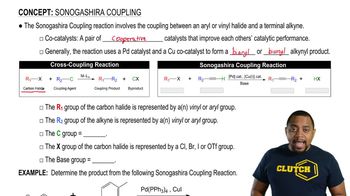
Sonogashira Coupling Reaction