Ch. 13 - Nuclear Magnetic Resonance Spectroscopy
Wade - Organic Chemistry 9th Edition
Wade9th EditionOrganic ChemistryISBN: 9780135213728당신이 사용하는 게 아니라요?교과서 변경
13장, 문제 21a

Propose chemical structures consistent with the following NMR spectra and molecular formulas. In spectrum (a), explain why the peaks around δ1.65 and δ3.75 are not clean multiplets, but show complex splitting.
(a) <IMAGE>

검증된 단계별 안내
1
Step 1: Analyze the molecular formula C₄H₁₀O₂. This indicates the presence of 4 carbons, 10 hydrogens, and 2 oxygen atoms. The molecule could be an ether or alcohol, as these functional groups commonly contain oxygen atoms.
Step 2: Examine the NMR spectrum. Peaks around δ1.65 and δ3.75 show complex splitting patterns. This suggests that the protons responsible for these signals are experiencing coupling with multiple neighboring protons, leading to intricate splitting.
Step 3: Consider the peak at δ1.65. This region typically corresponds to protons on carbons adjacent to other functional groups, such as alcohols or ethers. The complex splitting indicates coupling with protons on nearby carbons, possibly in a branched structure.
Step 4: Examine the peak at δ3.75. This region is characteristic of protons on carbons directly bonded to oxygen atoms (e.g., in ethers or alcohols). The complex splitting suggests coupling with protons on adjacent carbons, which could be part of a chain or branch.
Step 5: Propose a structure consistent with the molecular formula and NMR data. A plausible structure is a branched ether or alcohol, such as 2-methoxypropane or 2,2-dimethoxypropane. These structures align with the observed splitting patterns and chemical shifts.

비슷한 문제에 대한 검증된 영상 답변:

이 영상 해법은 위 문제에 도움이 된다고 튜터들이 추천한 것입니다.
영상 길이:
7m
도움이 되었나요?

주요 개념

질문에 올바르게 답하기 위해 반드시 이해해야 하는 핵심 개념들은 다음과 같습니다.

Nuclear Magnetic Resonance (NMR) Spectroscopy

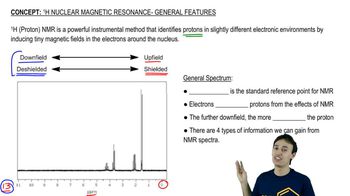
NMR spectroscopy is a powerful analytical technique used to determine the structure of organic compounds. It relies on the magnetic properties of certain nuclei, primarily hydrogen (1H) and carbon (13C), to provide information about the number of hydrogen atoms, their environment, and how they are connected. The chemical shift (δ) indicates the electronic environment of the nuclei, while the splitting patterns reveal the number of neighboring hydrogen atoms.
추천 영상:
10:06
General NMR Features

Multiplet Splitting in NMR

In NMR, peaks can appear as multiplets due to the interaction of a nucleus with neighboring nuclei, a phenomenon known as spin-spin coupling. The complexity of the splitting pattern depends on the number of adjacent hydrogen atoms and their arrangement. Clean multiplets indicate simple coupling, while complex splitting suggests multiple interactions, often due to overlapping signals from different types of protons or conformational changes in the molecule.
추천 영상:
06:46
1H NMR Integration

Chemical Environment and Peak Integration

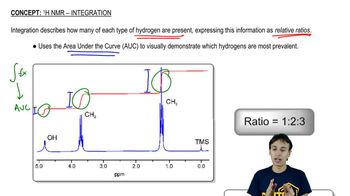
The chemical environment of protons affects their resonance frequency, leading to distinct peaks in an NMR spectrum. Peaks at different δ values correspond to protons in different electronic environments, influenced by factors like electronegativity and hybridization. Peak integration provides quantitative information about the number of protons contributing to each signal, which is essential for deducing the molecular formula and structure of the compound.
추천 영상:
06:46
1H NMR Integration