Ch. 13 - Nuclear Magnetic Resonance Spectroscopy
Wade - Organic Chemistry 9th Edition
Wade9th EditionOrganic ChemistryISBN: 9780135213728당신이 사용하는 게 아니라요?교과서 변경
13장, 문제 23

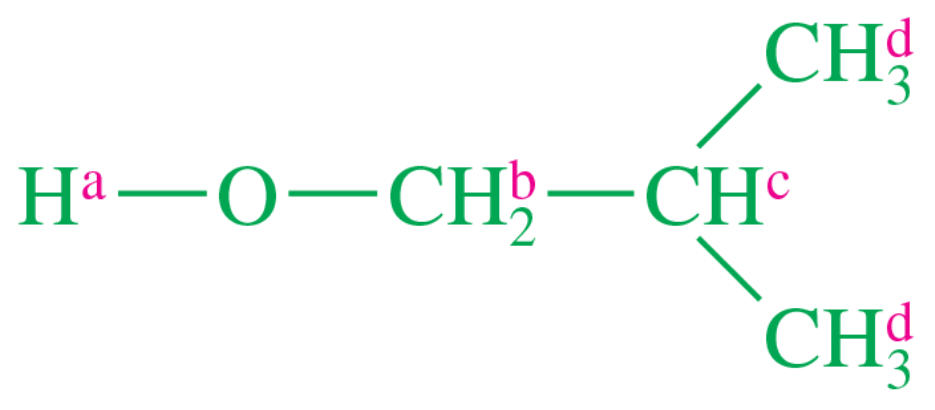
Give the spectral assignments for the protons in isobutyl alcohol (Solved Problem 13-4). For example, Ha is a singlet, area = 1, at δ2.4.

검증된 단계별 안내
1
Step 1: Identify the structure of isobutyl alcohol (3-methylbutan-2-ol) and locate the different types of protons in the molecule. The molecule contains the following proton environments: Ha (hydroxyl proton), Hb (methylene protons), Hc (methine proton), and Hd (methyl protons).
Step 2: Assign the chemical shift (δ) values for each type of proton based on their electronic environment. Ha (hydroxyl proton) is deshielded due to the electronegativity of oxygen and typically appears around δ 2-4 ppm. Hb (methylene protons) are slightly deshielded due to their proximity to the hydroxyl group and appear around δ 3-4 ppm. Hc (methine proton) is deshielded due to the branching and appears around δ 1-2 ppm. Hd (methyl protons) are shielded and appear around δ 0.9-1.5 ppm.
Step 3: Determine the splitting pattern for each type of proton based on the number of neighboring protons (n+1 rule). Ha (hydroxyl proton) typically appears as a singlet due to rapid exchange with solvent. Hb (methylene protons) are split into a doublet by Hc. Hc (methine proton) is split into a multiplet by Hb and Hd. Hd (methyl protons) are split into a doublet by Hc.
Step 4: Assign the integration (area under the peak) for each type of proton based on the number of equivalent protons. Ha corresponds to 1 proton, Hb corresponds to 2 protons, Hc corresponds to 1 proton, and Hd corresponds to 6 protons (two equivalent methyl groups).
Step 5: Summarize the spectral assignments: Ha is a singlet, area = 1, at δ 2-4 ppm; Hb is a doublet, area = 2, at δ 3-4 ppm; Hc is a multiplet, area = 1, at δ 1-2 ppm; Hd is a doublet, area = 6, at δ 0.9-1.5 ppm.

비슷한 문제에 대한 검증된 영상 답변:

이 영상 해법은 위 문제에 도움이 된다고 튜터들이 추천한 것입니다.
영상 길이:
4m
도움이 되었나요?

주요 개념

질문에 올바르게 답하기 위해 반드시 이해해야 하는 핵심 개념들은 다음과 같습니다.

Nuclear Magnetic Resonance (NMR) Spectroscopy

NMR spectroscopy is a powerful analytical technique used to determine the structure of organic compounds. It provides information about the number and environment of hydrogen atoms (protons) in a molecule, allowing chemists to identify different types of protons based on their chemical shifts (δ) and splitting patterns. Understanding NMR is crucial for interpreting the spectral data of isobutyl alcohol.
추천 영상:
10:06
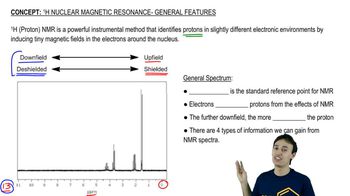
General NMR Features

Chemical Shifts (δ)

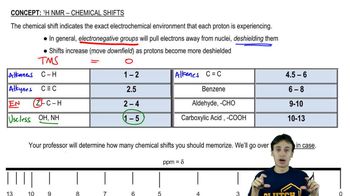
Chemical shifts (δ) in NMR spectroscopy indicate the resonance frequency of a nucleus relative to a standard reference. They are measured in parts per million (ppm) and provide insight into the electronic environment surrounding the protons. Different functional groups and molecular environments lead to distinct chemical shifts, which are essential for assigning protons in isobutyl alcohol.
추천 영상:
11:44
1H NMR Chemical Shifts

Multiplicity and Integration

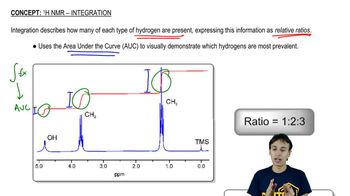
Multiplicity refers to the splitting pattern of NMR signals, which arises from the interaction of neighboring protons (n+1 rule). Integration indicates the relative number of protons contributing to a particular signal, providing information about the area under the peak. Together, these concepts help in identifying and assigning the protons in isobutyl alcohol, as seen in the spectral assignments.
추천 영상:
06:46
1H NMR Integration