
Ch. 14 - Ethers, Epoxides, and Thioethers
Wade - Organic Chemistry 9th Edition
Wade9th EditionOrganic ChemistryISBN: 9780135213728당신이 사용하는 게 아니라요?교과서 변경
14장, 문제 5

1,4-Dioxane is made commercially by the acid-catalyzed condensation of an alcohol.
(a) Show what alcohol will undergo condensation, with loss of water, to give 1,4-dioxane.
(b) Propose a mechanism for this reaction.

검증된 단계별 안내
1
Step 1: Identify the structure of 1,4-dioxane. It is a six-membered cyclic ether containing two oxygen atoms at positions 1 and 4. This structure suggests that the alcohol used in the condensation reaction must have two hydroxyl groups (-OH) separated by two carbon atoms.
Step 2: Determine the alcohol that can form 1,4-dioxane. The alcohol must be a diol (a molecule with two hydroxyl groups). Specifically, the alcohol should be 1,2-ethanediol (ethylene glycol, HOCH₂CH₂OH), as it has the correct spacing between hydroxyl groups to form the cyclic structure of 1,4-dioxane.
Step 3: Understand the acid-catalyzed condensation reaction. In the presence of an acid catalyst, the hydroxyl groups of ethylene glycol undergo protonation, making them more reactive. This leads to the loss of water (H₂O) and the formation of the cyclic ether (1,4-dioxane).
Step 4: Propose the mechanism for the reaction. (a) Protonation of one hydroxyl group occurs, forming a good leaving group (water). (b) The second hydroxyl group attacks the carbocation formed after water leaves, creating a cyclic intermediate. (c) Deprotonation of the oxygen atom in the cyclic intermediate completes the formation of 1,4-dioxane.
Step 5: Summarize the reaction. The acid catalyst facilitates the condensation of ethylene glycol by promoting the loss of water and the formation of the cyclic ether, 1,4-dioxane, through a series of protonation, nucleophilic attack, and deprotonation steps.

비슷한 문제에 대한 검증된 영상 답변:

이 영상 해법은 위 문제에 도움이 된다고 튜터들이 추천한 것입니다.
영상 길이:
17m
도움이 되었나요?

주요 개념

질문에 올바르게 답하기 위해 반드시 이해해야 하는 핵심 개념들은 다음과 같습니다.

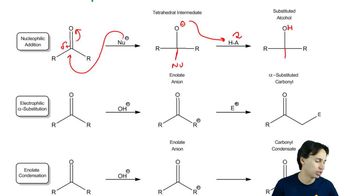
Condensation Reaction

A condensation reaction is a chemical process where two molecules combine to form a larger molecule, accompanied by the loss of a small molecule, often water. In the case of 1,4-dioxane, the condensation involves two alcohol molecules that lose water to form the cyclic ether. Understanding this reaction type is crucial for predicting the products and the conditions required for the synthesis.
추천 영상:
05:53
Condensation Reactions

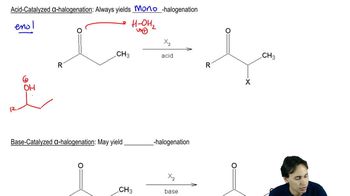
Acid-Catalyzed Reaction

An acid-catalyzed reaction involves the use of an acid to increase the rate of a chemical reaction. In the synthesis of 1,4-dioxane, the acid protonates the alcohol, making it a better leaving group and facilitating the formation of the cyclic structure. Recognizing the role of the acid catalyst is essential for understanding the mechanism and the reaction conditions.
추천 영상:
03:09
Acid Catalyzed

Mechanism of Dioxane Formation

The mechanism for the formation of 1,4-dioxane typically involves the formation of a protonated alcohol, followed by nucleophilic attack and the elimination of water. This stepwise process leads to the formation of the dioxane ring. A clear grasp of the mechanism is vital for predicting reaction pathways and understanding the stability of intermediates.
추천 영상:
02:26
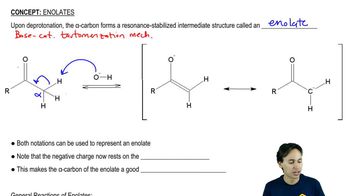
Formation of Enolates