

Ch. 14 - Ethers, Epoxides, and Thioethers
Wade - Organic Chemistry 9th Edition
Wade9th EditionOrganic ChemistryISBN: 9780135213728당신이 사용하는 게 아니라요?교과서 변경
14장, 문제 8

Propose a Williamson synthesis of 3-butoxy-1,1-dimethylcyclohexane from 3,3-dimethyl-cyclohexanol and butan-1-ol.

검증된 단계별 안내
1
Identify the target ether product: The target compound is 3-butoxy-1,1-dimethylcyclohexane, which is an ether. Williamson synthesis involves the reaction of an alkoxide ion with an alkyl halide to form an ether.
Determine the two components needed for the Williamson synthesis: The ether can be formed by reacting an alkoxide derived from 3,3-dimethylcyclohexanol with an alkyl halide derived from butan-1-ol.
Convert 3,3-dimethylcyclohexanol into its alkoxide: React 3,3-dimethylcyclohexanol with a strong base such as sodium hydride (NaH) or sodium metal (Na) to deprotonate the alcohol and form the alkoxide ion \( \text{(3,3-dimethylcyclohexoxide)} \).
Prepare the alkyl halide from butan-1-ol: React butan-1-ol with a halogenating agent such as phosphorus tribromide (PBr₃) or thionyl chloride (SOCl₂) to convert it into 1-bromobutane or 1-chlorobutane.
Perform the Williamson synthesis: React the 3,3-dimethylcyclohexoxide ion with the alkyl halide (e.g., 1-bromobutane) in an aprotic solvent such as dimethyl sulfoxide (DMSO) or acetone. This reaction proceeds via an \( S_N2 \) mechanism, resulting in the formation of 3-butoxy-1,1-dimethylcyclohexane.

비슷한 문제에 대한 검증된 영상 답변:

이 영상 해법은 위 문제에 도움이 된다고 튜터들이 추천한 것입니다.
영상 길이:
6m
도움이 되었나요?

주요 개념

질문에 올바르게 답하기 위해 반드시 이해해야 하는 핵심 개념들은 다음과 같습니다.

Williamson Ether Synthesis

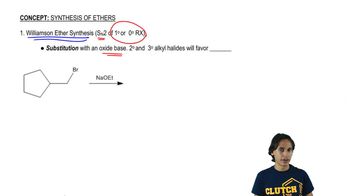
The Williamson ether synthesis is a method for creating ethers through the reaction of an alkoxide ion with a primary alkyl halide. This reaction typically involves the nucleophilic substitution mechanism (SN2), where the alkoxide acts as a nucleophile, attacking the electrophilic carbon of the alkyl halide, resulting in the formation of an ether.
추천 영상:
가이드 코스
03:50
The Mechanism of Williamson Ether Synthesis.

Nucleophilic Substitution Mechanism

Nucleophilic substitution is a fundamental reaction mechanism in organic chemistry where a nucleophile replaces a leaving group in a molecule. In the case of the Williamson synthesis, the nucleophile is the alkoxide ion, and the leaving group is typically a halide. The mechanism can be either SN1 or SN2, with SN2 being preferred for primary alkyl halides due to steric accessibility.
추천 영상:
가이드 코스
01:47
Nucleophiles and Electrophiles can react in Substitution Reactions.

Sterics and Reactivity

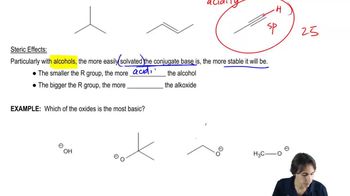
Sterics refers to the spatial arrangement of atoms in a molecule and how this affects reactivity. In the Williamson synthesis, steric hindrance can influence the choice of alkyl halide; primary halides are more reactive in SN2 reactions than secondary or tertiary halides. Understanding sterics is crucial for predicting the outcome of the synthesis and ensuring successful ether formation.
추천 영상:
가이드 코스
02:53
Understanding steric effects.