
Ch. 14 - Ethers, Epoxides, and Thioethers
Wade - Organic Chemistry 9th Edition
Wade9th EditionOrganic ChemistryISBN: 9780135213728당신이 사용하는 게 아니라요?교과서 변경
14장, 문제 7

Propose a fragmentation to account for each numbered peak in the mass spectrum of n-butyl isopropyl ether.
<IMAGE>

검증된 단계별 안내
1
Identify the molecular structure of n-butyl isopropyl ether. It consists of a butyl group (C4H9) attached to an oxygen atom, which is further connected to an isopropyl group (C3H7). The molecular formula is C7H16O.
Understand the process of fragmentation in mass spectrometry. Fragmentation occurs when the molecule is ionized, leading to the breaking of bonds and the formation of smaller ionized fragments. These fragments correspond to the peaks in the mass spectrum.
Propose a fragmentation pathway for the first peak. A common fragmentation involves the cleavage of the bond between the oxygen atom and the butyl group, resulting in a butyl cation (C4H9⁺) and an isopropoxy radical (C3H7O•). The mass of the butyl cation can be calculated as follows: \( \text{C}_4\text{H}_9^+ \) = \( 4(12.01) + 9(1.008) \).
Propose a fragmentation pathway for the second peak. Another possible fragmentation involves the cleavage of the bond between the oxygen atom and the isopropyl group, resulting in an isopropyl cation (C3H7⁺) and a butoxy radical (C4H9O•). The mass of the isopropyl cation can be calculated as follows: \( \text{C}_3\text{H}_7^+ \) = \( 3(12.01) + 7(1.008) \).
Analyze additional peaks by considering secondary fragmentations or rearrangements. For example, the butyl cation (C4H9⁺) can undergo further fragmentation to form smaller ions such as the ethyl cation (C2H5⁺) or propyl cation (C3H7⁺). Similarly, the isopropyl cation (C3H7⁺) can fragment further to form smaller ions. Calculate the masses of these smaller ions to match them with the peaks in the spectrum.

비슷한 문제에 대한 검증된 영상 답변:

이 영상 해법은 위 문제에 도움이 된다고 튜터들이 추천한 것입니다.
영상 길이:
5m
도움이 되었나요?

주요 개념

질문에 올바르게 답하기 위해 반드시 이해해야 하는 핵심 개념들은 다음과 같습니다.

Mass Spectrometry

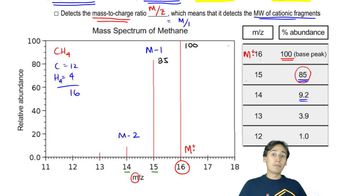
Mass spectrometry is an analytical technique used to measure the mass-to-charge ratio of ions. It involves ionizing chemical species and sorting the ions based on their mass. The resulting mass spectrum displays peaks corresponding to different ions, where the height of each peak indicates the relative abundance of each ion. Understanding mass spectrometry is crucial for interpreting the fragmentation patterns of compounds.
추천 영상:
가이드 코스
01:25
How to Read a Mass Spectrum

Fragmentation Patterns

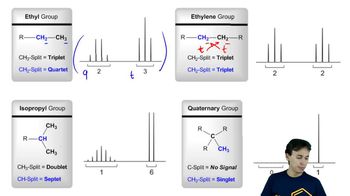
Fragmentation patterns refer to the specific ways in which a molecule breaks apart into smaller ions during mass spectrometry. These patterns are influenced by the molecular structure and the stability of the resulting fragments. Analyzing fragmentation helps in identifying the structure of the original compound, as each peak in the mass spectrum corresponds to a specific fragment formed during ionization.
추천 영상:
가이드 코스
08:06
Common Splitting Patterns

n-Butyl Isopropyl Ether Structure

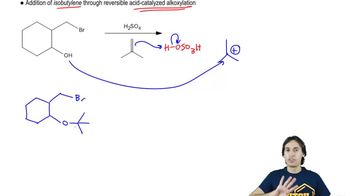
n-Butyl isopropyl ether is an organic compound with a specific structure that influences its fragmentation behavior. It consists of a butyl group (C4H9) and an isopropyl group (C3H7) connected by an ether linkage (R-O-R'). Understanding the molecular structure is essential for predicting how the compound will fragment under ionization, which directly relates to the peaks observed in its mass spectrum.
추천 영상:
가이드 코스
05:49
Mechanism of t-Butyl Ether Protecting Groups.