Ch. 14 - Ethers, Epoxides, and Thioethers
Wade - Organic Chemistry 9th Edition
Wade9th EditionOrganic ChemistryISBN: 9780135213728당신이 사용하는 게 아니라요?교과서 변경
14장, 문제 16

Boron tribromide (BBr3) cleaves ethers to give alkyl halides and alcohols.

The reaction is thought to involve attack by a bromide ion on the Lewis acid–base adduct of the ether with BBr3 (a strong Lewis acid). Propose a mechanism for the reaction of butyl methyl ether with BBr3 to give (after hydrolysis) butan-1-ol and bromomethane.

검증된 단계별 안내
1
Step 1: Recognize the role of BBr3 as a strong Lewis acid. It interacts with the ether oxygen atom, which has lone pairs of electrons, forming a Lewis acid-base adduct. This interaction increases the electrophilicity of the ether oxygen, making it more susceptible to nucleophilic attack.
Step 2: Propose the first step of the mechanism. The ether (butyl methyl ether, CH3-O-C4H9) reacts with BBr3 to form a Lewis acid-base adduct. This can be represented as CH3-O-C4H9 + BBr3 → CH3-O-BBr2-C4H9. The oxygen atom donates a lone pair to the boron atom, forming a coordinate covalent bond.
Step 3: Introduce the nucleophilic attack by bromide ion (Br⁻). The bromide ion attacks the carbon atom of the methyl group (CH3) in the ether, leading to cleavage of the C-O bond. This results in the formation of bromomethane (CH3Br) and a butoxyboron intermediate (C4H9-O-BBr2).
Step 4: Describe the hydrolysis step. The butoxyboron intermediate (C4H9-O-BBr2) undergoes hydrolysis in the presence of water. This reaction produces butan-1-ol (C4H9OH), boric acid (B(OH)3), and hydrogen bromide (HBr).
Step 5: Summarize the overall reaction. The mechanism involves the formation of a Lewis acid-base adduct, nucleophilic attack by bromide ion, cleavage of the ether bond, and subsequent hydrolysis to yield the final products: butan-1-ol (C4H9OH) and bromomethane (CH3Br).

비슷한 문제에 대한 검증된 영상 답변:

이 영상 해법은 위 문제에 도움이 된다고 튜터들이 추천한 것입니다.
영상 길이:
4m
도움이 되었나요?

주요 개념

질문에 올바르게 답하기 위해 반드시 이해해야 하는 핵심 개념들은 다음과 같습니다.

Lewis Acids and Bases

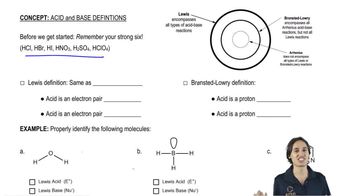
Lewis acids are substances that can accept an electron pair, while Lewis bases are those that can donate an electron pair. In the context of the reaction with BBr3, the ether acts as a Lewis base, forming a complex with the Lewis acid BBr3. This interaction is crucial for the subsequent steps of the reaction, as it facilitates the cleavage of the ether bond.
추천 영상:
가이드 코스
02:49
The Lewis definition of acids and bases.

Ethers and Their Cleavage

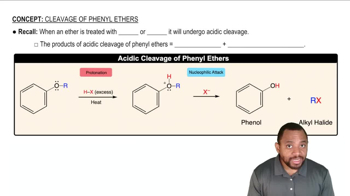
Ethers are organic compounds characterized by an oxygen atom bonded to two alkyl or aryl groups. The cleavage of ethers typically involves breaking the C-O bond, which can be achieved through various reagents, including strong Lewis acids like BBr3. Understanding the mechanism of ether cleavage is essential for predicting the products formed in the reaction.
추천 영상:
1:45
Cleavage of Phenyl Ethers Concept 1

Nucleophilic Substitution Reactions

Nucleophilic substitution reactions involve the replacement of a leaving group by a nucleophile. In the proposed mechanism, the bromide ion acts as a nucleophile that attacks the carbon atom bonded to the leaving group (the alkyl part of the ether). This step is critical for generating the alkyl halide and alcohol products after hydrolysis.
추천 영상:
가이드 코스
01:47
Nucleophiles and Electrophiles can react in Substitution Reactions.