Ch. 14 - Ethers, Epoxides, and Thioethers
Wade - Organic Chemistry 9th Edition
Wade9th EditionOrganic ChemistryISBN: 9780135213728당신이 사용하는 게 아니라요?교과서 변경
14장, 문제 17

Show how you would synthesize butyl isopropyl sulfide using butan-1-ol, propan-2-ol, and any solvents and reagents you need.

검증된 단계별 안내
1
Step 1: Convert butan-1-ol to butyl bromide. This can be achieved by reacting butan-1-ol with phosphorus tribromide (PBr₃) or hydrobromic acid (HBr) to replace the hydroxyl group (-OH) with a bromine atom, forming butyl bromide (C₄H₉Br).
Step 2: Convert propan-2-ol to isopropyl thiol. React propan-2-ol with phosphorus pentasulfide (P₂S₅) or Lawesson's reagent to replace the hydroxyl group (-OH) with a thiol group (-SH), forming isopropyl thiol (C₃H₇SH).
Step 3: Perform a nucleophilic substitution reaction. React butyl bromide (C₄H₉Br) with isopropyl thiol (C₃H₇SH) in the presence of a strong base such as sodium hydroxide (NaOH) or potassium hydroxide (KOH). The thiol group (-SH) will act as a nucleophile, displacing the bromine atom and forming butyl isopropyl sulfide (C₄H₉-S-C₃H₇).
Step 4: Purify the product. Use techniques such as distillation or recrystallization to isolate and purify the butyl isopropyl sulfide from the reaction mixture.
Step 5: Confirm the structure of the product. Use spectroscopic methods such as NMR (nuclear magnetic resonance) or IR (infrared spectroscopy) to verify the formation of butyl isopropyl sulfide and ensure the reaction was successful.

비슷한 문제에 대한 검증된 영상 답변:

이 영상 해법은 위 문제에 도움이 된다고 튜터들이 추천한 것입니다.
영상 길이:
5m
도움이 되었나요?

주요 개념

질문에 올바르게 답하기 위해 반드시 이해해야 하는 핵심 개념들은 다음과 같습니다.

Nucleophilic Substitution

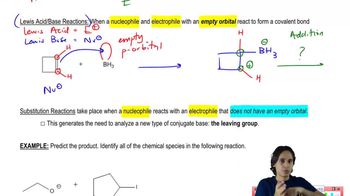
Nucleophilic substitution is a fundamental reaction in organic chemistry where a nucleophile attacks an electrophile, resulting in the replacement of a leaving group. In the synthesis of butyl isopropyl sulfide, the nucleophilic attack of the alcohols on a suitable electrophile (like a sulfonyl chloride) is crucial for forming the desired sulfide bond.
추천 영상:
가이드 코스
01:47
Nucleophiles and Electrophiles can react in Substitution Reactions.

Alcohols as Reactants

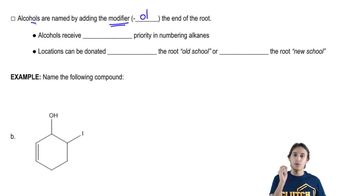
Butan-1-ol and propan-2-ol are alcohols that can act as nucleophiles in organic reactions. Their hydroxyl (-OH) groups can be converted into better leaving groups, such as tosylates or mesylates, facilitating the nucleophilic substitution process. Understanding how to activate these alcohols is essential for the successful synthesis of butyl isopropyl sulfide.
추천 영상:
가이드 코스
01:01
How to name alcohols

Solvent Effects

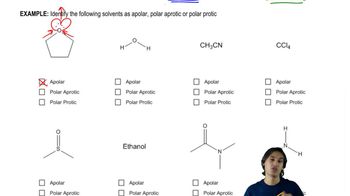
The choice of solvent can significantly influence the rate and outcome of organic reactions. Polar protic solvents can stabilize ions and facilitate nucleophilic attacks, while polar aprotic solvents can enhance nucleophilicity. Selecting the appropriate solvent for the reaction involving butan-1-ol and propan-2-ol is vital for optimizing the synthesis of butyl isopropyl sulfide.
추천 영상:
가이드 코스
01:16
Identification of polarity in solvents
관련 실천
교과서 질문

Show how you would accomplish the following transformations. Some of these examples require more than one step.

(a) 2-methylpropene → 2,2-dimethyloxirane

(b) 1-phenylethanol → 2-phenyloxirane

(c) 5-chloropent-1-ene → tetrahydropyran

1111
views
교과서 질문

Predict the products of the following reactions. An excess of acid is available in each case.

(d)

765
views
교과서 질문

Boron tribromide (BBr3) cleaves ethers to give alkyl halides and alcohols.

The reaction is thought to involve attack by a bromide ion on the Lewis acid–base adduct of the ether with BBr3 (a strong Lewis acid). Propose a mechanism for the reaction of butyl methyl ether with BBr3 to give (after hydrolysis) butan-1-ol and bromomethane.

1579
views
교과서 질문

Predict the products of the following reactions. An excess of acid is available in each case.

(c) anisole (methoxybenzene) + HBr

760
views
교과서 질문

Show how you would use a protecting group to convert 4-bromobutan-1-ol to hept-5-yn-1-ol.

1196
views
교과서 질문

Mustard gas, Cl–CH2CH2–S–CH2CH2–Cl, was used as a poisonous chemical agent in World War I. Mustard gas is much more toxic than a typical primary alkyl chloride. Its toxicity stems from its ability to alkylate amino groups on important metabolic enzymes, rendering the enzymes inactive.

a. Propose a mechanism to explain why mustard gas is an exceptionally potent alkylating agent.

b. Bleach (sodium hypochlorite, NaOCl, a strong oxidizing agent) neutralizes and inactivates mustard gas. Bleach is also effective on organic stains because it oxidizes colored compounds to colorless compounds. Propose products that might be formed by the reaction of mustard gas with bleach.

1173
views