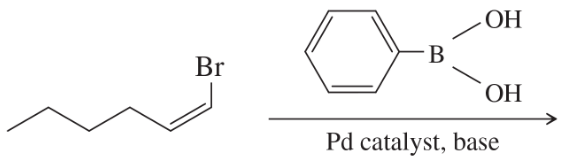
Give the structures of compounds A through B in the following series of reactions.
Ch. 17 - Reactions of Aromatic Compounds
17장, 문제 55c
What products would you expect from the following coupling reactions?
(c) 
검증된 단계별 안내1
Step 1: Recognize the reaction type. This is a Suzuki coupling reaction, which involves the reaction of an organoboron compound (here, a phenylboronic acid derivative) with an organohalide (here, an allyl bromide) in the presence of a palladium catalyst and a base.
Step 2: Identify the components. The phenylboronic acid derivative provides the aryl group, while the allyl bromide provides the allyl group. The palladium catalyst facilitates the formation of a new carbon-carbon bond between these two groups.
Step 3: Understand the mechanism. The reaction proceeds through oxidative addition of the allyl bromide to the palladium catalyst, transmetalation with the phenylboronic acid derivative, and reductive elimination to form the coupled product.
Step 4: Predict the product. The new bond forms between the carbon atom of the phenyl group (from the boronic acid) and the carbon atom of the allyl group (from the allyl bromide). The product will be an aryl-allyl compound.
Step 5: Verify the structure. The final product will have the phenyl group directly bonded to the allyl group, maintaining the double bond in the allyl group and the methyl substituent on the allyl chain.

비슷한 문제에 대한 검증된 영상 답변:
이 영상 해법은 위 문제에 도움이 된다고 튜터들이 추천한 것입니다.
영상 길이:
4m주요 개념
질문에 올바르게 답하기 위해 반드시 이해해야 하는 핵심 개념들은 다음과 같습니다.
Suzuki Coupling Reaction
The Suzuki coupling reaction is a widely used method in organic chemistry for forming carbon-carbon bonds. It involves the reaction of a boronic acid with an organic halide in the presence of a palladium catalyst and a base. This reaction is particularly valuable for synthesizing biaryl compounds and other complex organic molecules.
Palladium Catalysis
Palladium catalysis is crucial in many cross-coupling reactions, including the Suzuki reaction. Palladium serves as a catalyst that facilitates the oxidative addition of the organic halide and the subsequent transmetalation with the boronic acid. The ability of palladium to cycle between different oxidation states allows it to effectively promote these reactions.
Base in Coupling Reactions
In coupling reactions like the Suzuki reaction, a base is essential for deprotonating the boronic acid, generating a more reactive boronate species. The base also helps to neutralize the acidic byproducts formed during the reaction. Common bases used include sodium hydroxide or potassium carbonate, which enhance the efficiency of the coupling process.
관련 실천
교과서 질문
932
views
교과서 질문
What products would you expect from the following coupling reactions?
(a)
1340
views
교과서 질문
What products would you expect from the following coupling reactions?
(b)
1470
views
교과서 질문
Predict the major products of bromination of the following compounds, using Br2 and FeBr3 in the dark.
(c)
2145
views
교과서 질문
What products would you expect from the following coupling reactions?
(d)
(e)
950
views
교과서 질문
A student added 3-phenylpropanoic acid (PhCH2CH2COOH) to a molten salt consisting of a 1:1 mixture of NaCl and AlCl3 maintained at 170 °C. After 5 minutes, he poured the molten mixture into water and extracted it into dichloromethane. Evaporation of the dichloromethane gave a 96% yield of the product whose spectra follow. The mass spectrum of the product shows a molecular ion at m/z 132. What is the product?
<IMAGE>
1721
views