Ch. 17 - Reactions of Aromatic Compounds
Wade - Organic Chemistry 9th Edition
Wade9th EditionOrganic ChemistryISBN: 9780135213728당신이 사용하는 게 아니라요?교과서 변경
17장, 문제 55d,e

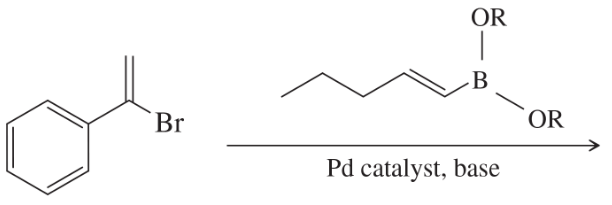
What products would you expect from the following coupling reactions?
(d)
(e)

검증된 단계별 안내
1
Step 1: Identify the type of coupling reaction. The first reaction involves a bromobenzene derivative and a boronic ester, which suggests a Suzuki coupling reaction. The second reaction involves a bromonaphthalene derivative and a nitro-substituted styrene, which suggests a Heck coupling reaction.
Step 2: For the Suzuki coupling reaction, the palladium catalyst facilitates the cross-coupling between the aryl bromide and the boronic ester. The base activates the boronic ester, allowing it to react with the aryl bromide. The product will be a new C-C bond formed between the phenyl group and the alkene chain attached to the boron.
Step 3: For the Heck coupling reaction, the palladium catalyst and base facilitate the formation of a C-C bond between the aryl bromide and the alkene. The nitro-substituted styrene will couple with the bromonaphthalene derivative, forming a new C-C bond at the β-position of the alkene relative to the nitro group.
Step 4: Consider regioselectivity and stereochemistry. In the Suzuki reaction, the product will retain the stereochemistry of the alkene in the boronic ester. In the Heck reaction, the product will likely favor the trans configuration of the alkene due to steric and electronic factors.
Step 5: Write the final structures of the products. For the Suzuki reaction, the product will be a phenyl group attached to the alkene chain. For the Heck reaction, the product will be a naphthalene group attached to the β-position of the nitro-substituted styrene alkene.

비슷한 문제에 대한 검증된 영상 답변:

이 영상 해법은 위 문제에 도움이 된다고 튜터들이 추천한 것입니다.
영상 길이:
4m

주요 개념

질문에 올바르게 답하기 위해 반드시 이해해야 하는 핵심 개념들은 다음과 같습니다.

Coupling Reactions

Coupling reactions are organic reactions where two fragments are joined together, typically involving the formation of a new carbon-carbon bond. These reactions are crucial in organic synthesis, particularly in the formation of complex molecules. Common types include Suzuki, Heck, and Sonogashira reactions, each utilizing different reagents and conditions to achieve the desired product.
추천 영상:
02:54
Sonogashira Coupling Reaction

Reactivity of Functional Groups

Understanding the reactivity of functional groups is essential in predicting the outcomes of coupling reactions. Different functional groups, such as halides, alcohols, and amines, have distinct reactivity patterns that influence how they participate in reactions. Recognizing these patterns helps in determining which groups can effectively couple and what products will form.
추천 영상:
02:36
Identifying Functional Groups

Mechanism of Reactions

The mechanism of a reaction outlines the step-by-step process by which reactants are converted into products. In coupling reactions, mechanisms often involve the formation of intermediates and the breaking and forming of bonds. A clear understanding of these mechanisms allows chemists to predict reaction outcomes and optimize conditions for desired products.
추천 영상:
02:16
Heck Reaction Mechanism