
Ch. 20 - Carboxylic Acids
Wade - Organic Chemistry 9th Edition
Wade9th EditionOrganic ChemistryISBN: 9780135213728당신이 사용하는 게 아니라요?교과서 변경
20장, 문제 8c

How many stereoisomers are possible for c. a ketotriose?

검증된 단계별 안내
1
Identify the molecular structure of a ketotriose. A ketotriose is a three-carbon sugar (triose) containing a ketone functional group. The general structure is CH2OH-C(=O)-CHOH.
Determine the number of chiral centers in the molecule. A chiral center is a carbon atom bonded to four different groups. In a ketotriose, the middle carbon (C2) is the only chiral center because it is attached to a hydroxyl group (-OH), a hydrogen atom (H), a ketone group (C=O), and a methyl group (CH2OH).
Use the formula for calculating the number of stereoisomers: 2^n, where n is the number of chiral centers. Since there is one chiral center (n = 1), substitute this value into the formula.
Interpret the result of the formula. The number of stereoisomers corresponds to the possible configurations (R or S) of the chiral center.
Conclude that the ketotriose can exist in two stereoisomeric forms, which are enantiomers (non-superimposable mirror images). These forms are typically labeled as D- and L- configurations based on the orientation of the hydroxyl group at the chiral center.

비슷한 문제에 대한 검증된 영상 답변:

이 영상 해법은 위 문제에 도움이 된다고 튜터들이 추천한 것입니다.
영상 길이:
3m

주요 개념

질문에 올바르게 답하기 위해 반드시 이해해야 하는 핵심 개념들은 다음과 같습니다.

Stereoisomerism

Stereoisomerism refers to the phenomenon where compounds have the same molecular formula and connectivity of atoms but differ in the spatial arrangement of their atoms. This can lead to different physical and chemical properties. In carbohydrates, stereoisomers arise due to the presence of chiral centers, which are carbon atoms bonded to four different groups.
추천 영상:
01:58
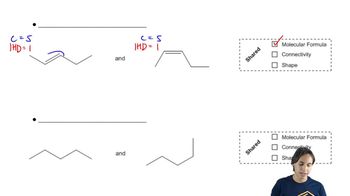
Determining when molecules are stereoisomers.

Chirality and Chiral Centers

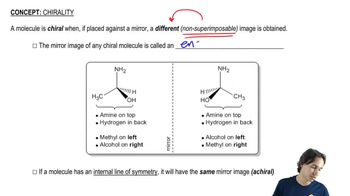
Chirality is a property of a molecule that makes it non-superimposable on its mirror image, much like left and right hands. In organic compounds, chiral centers are typically carbon atoms that are bonded to four distinct substituents. The presence of chiral centers in a molecule significantly increases the number of possible stereoisomers.
추천 영상:
05:10
What is chirality?

Calculating Stereoisomers

The number of stereoisomers for a compound can be calculated using the formula 2^n, where n is the number of chiral centers in the molecule. For a ketotriose, which has three carbon atoms and typically one or more chiral centers, this formula helps determine the total possible stereoisomers, considering that each chiral center can exist in two configurations (R or S).
추천 영상:
01:58
Determining when molecules are stereoisomers.
관련 실천
교과서 질문

Oxidation of a primary alcohol to an aldehyde usually gives some over-oxidation to the carboxylic acid. Assume you have used PCC to oxidize pentan-1-ol to pentanal.

(a) Show how you would use acid–base extraction to purify the pentanal.

(b) Which of the expected impurities cannot be removed from pentanal by acid–base extractions? How would you remove this impurity?

990
views
교과서 질문

Phenols are less acidic than carboxylic acids, with values of pKa around 10. Phenols are deprotonated by (and therefore soluble in) solutions of sodium hydroxide but not by solutions of sodium bicarbonate. Explain how you would use extractions to isolate the three pure compounds from a mixture of p-cresol (p-methylphenol), cyclohexanone, and benzoic acid.

2320
views
교과서 질문

Show how you would synthesize the following carboxylic acids, using the indicated starting materials.

(a) oct-4-yne → butanoic acid

(b) trans-cyclodecene → decanedioic acid

763
views
교과서 질문

Write the mechanism for the base-catalyzed conversion of D-fructose to D-glucose and D-mannose.

1104
views
교과서 질문

The IR spectrum of trans-oct-2-enoic acid is shown. Point out the spectral characteristics that allow you to tell that this is a carboxylic acid, and show which features lead you to conclude that the acid is unsaturated and conjugated.

<IMAGE>

1835
views
교과서 질문

Show how you would synthesize the following carboxylic acids, using the indicated starting materials.

(d) butan-2-ol → 2-methylbutanoic acid

665
views