Ch. 20 - Carboxylic Acids
Wade - Organic Chemistry 9th Edition
Wade9th EditionOrganic ChemistryISBN: 9780135213728당신이 사용하는 게 아니라요?교과서 변경
20장, 문제 11d

Show how you would synthesize the following carboxylic acids, using the indicated starting materials.
(d) butan-2-ol → 2-methylbutanoic acid

검증된 단계별 안내
1
Step 1: Begin by oxidizing butan-2-ol to form the corresponding ketone, butan-2-one. This can be achieved using an oxidizing agent such as PCC (Pyridinium Chlorochromate) or Jones reagent. The reaction involves the removal of two hydrogen atoms from the alcohol group.
Step 2: Perform a nucleophilic addition reaction to introduce a methyl group at the alpha-carbon of butan-2-one. This can be done using a Grignard reagent (e.g., CH3MgBr) or an organolithium reagent, followed by acidic workup to yield 3-methylbutan-2-ol.
Step 3: Oxidize 3-methylbutan-2-ol to form 3-methylbutan-2-one. Use an oxidizing agent such as PCC or Jones reagent to convert the secondary alcohol into a ketone.
Step 4: Perform a haloform reaction to convert 3-methylbutan-2-one into 2-methylbutanoic acid. This reaction involves treating the ketone with excess halogen (e.g., I2 or Br2) in the presence of a base (e.g., NaOH), followed by acidification to yield the carboxylic acid.
Step 5: Purify the 2-methylbutanoic acid product using techniques such as recrystallization or distillation, depending on the physical properties of the compound.

비슷한 문제에 대한 검증된 영상 답변:

이 영상 해법은 위 문제에 도움이 된다고 튜터들이 추천한 것입니다.
영상 길이:
1m

주요 개념

질문에 올바르게 답하기 위해 반드시 이해해야 하는 핵심 개념들은 다음과 같습니다.

Carboxylic Acid Synthesis

Carboxylic acids can be synthesized through various methods, including oxidation of alcohols. In this case, butan-2-ol can be oxidized to form a carboxylic acid. Understanding the reaction conditions and reagents required for oxidation is crucial for successful synthesis.
추천 영상:
04:20
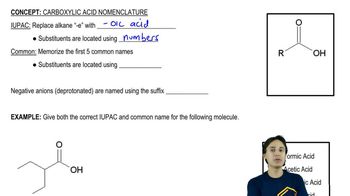
Carboxylic Acids Nomenclature

Oxidation Reactions

Oxidation reactions involve the loss of electrons or an increase in oxidation state, often resulting in the formation of carbonyl compounds or carboxylic acids from alcohols. For butan-2-ol, a common oxidizing agent like potassium dichromate or chromium trioxide can facilitate this transformation.
추천 영상:
03:20
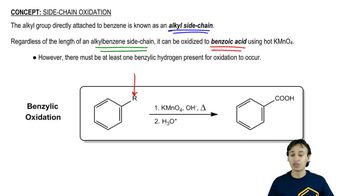
Benzylic Oxidation

Rearrangement and Isomerization

In organic synthesis, rearrangement and isomerization can lead to the formation of different structural isomers. The target compound, 2-methylbutanoic acid, suggests that the synthesis may involve a rearrangement of the carbon skeleton during the oxidation process, which is essential to achieve the desired product.
추천 영상:
06:08
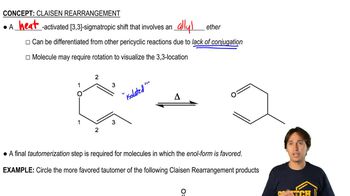
Definition of Claisen Rearrangement