Ch. 20 - Carboxylic Acids
Wade - Organic Chemistry 9th Edition
Wade9th EditionOrganic ChemistryISBN: 9780135213728당신이 사용하는 게 아니라요?교과서 변경
20장, 문제 11a,b

Show how you would synthesize the following carboxylic acids, using the indicated starting materials.
(a) oct-4-yne → butanoic acid
(b) trans-cyclodecene → decanedioic acid

검증된 단계별 안내
1
For part (a), oct-4-yne to butanoic acid: Begin by recognizing that oct-4-yne is an alkyne, and oxidative cleavage of alkynes can yield carboxylic acids. Use a strong oxidizing agent such as potassium permanganate (KMnO₄) or ozone (O₃) followed by hydrolysis to cleave the triple bond into two carboxylic acids. The cleavage will produce two molecules of butanoic acid since the alkyne is symmetrically substituted.
For part (a), ensure the reaction conditions are acidic or neutral during the oxidative cleavage to facilitate the formation of carboxylic acids from the intermediate products.
For part (b), trans-cyclodecene to decanedioic acid: Recognize that trans-cyclodecene is a cyclic alkene. Oxidative cleavage of alkenes can yield diacids if the double bond is part of a ring. Use ozone (O₃) followed by hydrogen peroxide (H₂O₂) or KMnO₄ under acidic conditions to cleave the double bond and open the ring, forming decanedioic acid.
For part (b), ensure the reaction conditions are carefully controlled to avoid over-oxidation or side reactions. The oxidative cleavage will break the double bond and introduce carboxylic acid groups at both ends of the resulting open-chain molecule.
Verify the products for both parts by analyzing the structures and ensuring the correct number of carbon atoms and functional groups are present in the final carboxylic acids.

비슷한 문제에 대한 검증된 영상 답변:

이 영상 해법은 위 문제에 도움이 된다고 튜터들이 추천한 것입니다.
영상 길이:
5m

주요 개념

질문에 올바르게 답하기 위해 반드시 이해해야 하는 핵심 개념들은 다음과 같습니다.

Carboxylic Acid Synthesis

Carboxylic acids can be synthesized through various methods, including oxidation of alcohols, hydrolysis of nitriles, and carbon chain elongation. Understanding the functional groups and reactivity of starting materials is crucial for determining the appropriate synthetic route. In this case, the transformation of alkynes and alkenes into carboxylic acids involves specific reactions that introduce the carboxyl group (-COOH) into the molecule.
추천 영상:
04:20
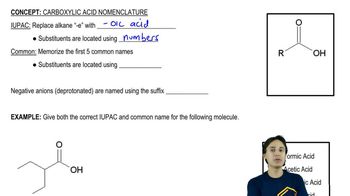
Carboxylic Acids Nomenclature

Alkyne Reactivity

Alkynes, characterized by a carbon-carbon triple bond, can undergo various reactions, including hydrolysis and oxidation. For the synthesis of butanoic acid from oct-4-yne, a key step involves the hydration of the alkyne to form a ketone, which can then be further oxidized to yield the desired carboxylic acid. Understanding the mechanisms of these reactions is essential for predicting the products formed during synthesis.
추천 영상:
09:11
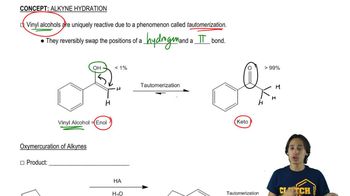
Alkyne Hydration

Cycloalkene Reactions

Cycloalkenes, such as trans-cyclodecene, can participate in reactions that lead to the formation of carboxylic acids. In this case, the ring-opening reaction followed by oxidation can be employed to synthesize decanedioic acid. Familiarity with the behavior of cyclic compounds and their reactivity patterns is important for successfully navigating the synthesis of complex molecules from simpler starting materials.
추천 영상:
01:11
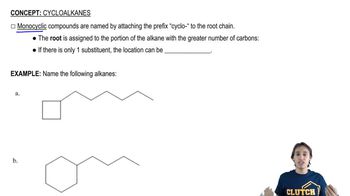
How to find the root name for cycloalkanes