Ch.9 - Alkynes
Wade - Organic Chemistry 9th Edition
Wade9th EditionOrganic ChemistryISBN: 9780135213728당신이 사용하는 게 아니라요?교과서 변경
9장, 문제 20a

The hydroboration–oxidation of internal alkynes produces ketones.
a. When hydroboration–oxidation is applied to but-2-yne, a single pure product is obtained. Determine the structure of this product, and show the intermediates in its ­formation.

검증된 단계별 안내
1
Step 1: Understand the reaction mechanism. Hydroboration–oxidation of alkynes involves two steps: (1) addition of borane (BH₃ or a derivative) to the alkyne, and (2) oxidation of the resulting organoborane intermediate with hydrogen peroxide (H₂O₂) in a basic medium (NaOH). For internal alkynes, this reaction typically produces ketones.
Step 2: Analyze the structure of the starting material. But-2-yne is a symmetrical internal alkyne with the structure CH₃-C≡C-CH₃. Its symmetry ensures that the hydroboration–oxidation will yield a single product.
Step 3: Describe the hydroboration step. In this step, a borane reagent (commonly disiamylborane or 9-BBN) adds across the triple bond of but-2-yne. The boron atom attaches to one of the carbons in the triple bond, while a hydrogen atom attaches to the other carbon. This step forms a trialkylborane intermediate.
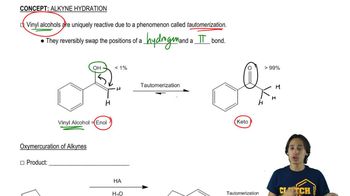
Step 4: Describe the oxidation step. The trialkylborane intermediate is treated with hydrogen peroxide (H₂O₂) in a basic medium (NaOH). This step replaces the boron atom with a hydroxyl group (-OH), resulting in an enol intermediate. The enol then tautomerizes to form a ketone, as the keto form is more stable.
Step 5: Determine the final product. Since but-2-yne is symmetrical, the ketone formed will be a single product: CH₃-CO-CH₃ (2-butanone). The intermediates include the trialkylborane and the enol forms, which are crucial in the reaction pathway.

비슷한 문제에 대한 검증된 영상 답변:

이 영상 해법은 위 문제에 도움이 된다고 튜터들이 추천한 것입니다.
영상 길이:
6m

주요 개념

질문에 올바르게 답하기 위해 반드시 이해해야 하는 핵심 개념들은 다음과 같습니다.

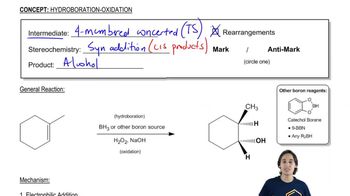
Hydroboration-Oxidation Reaction

The hydroboration-oxidation reaction is a two-step process used to convert alkenes and alkynes into alcohols. In the first step, borane (BH3) adds across the double or triple bond, forming a trialkylborane intermediate. The second step involves oxidation with hydrogen peroxide (H2O2) in the presence of a base, converting the boron atom into a hydroxyl group, resulting in an alcohol. This reaction is notable for its anti-Markovnikov selectivity.
추천 영상:
06:38
General properties of hydroboration-oxidation.

Alkyne Reactivity

Internal alkynes, such as but-2-yne, have a triple bond between two carbon atoms that can undergo various reactions, including hydroboration. The reactivity of alkynes is influenced by their structure; internal alkynes can form more stable intermediates compared to terminal alkynes. This stability allows for the formation of ketones upon hydroboration-oxidation, as the reaction proceeds through a more favorable pathway.
추천 영상:
09:11
Alkyne Hydration

Ketone Formation

Ketones are organic compounds characterized by a carbonyl group (C=O) flanked by two carbon atoms. In the context of hydroboration-oxidation of internal alkynes, the reaction leads to the formation of a ketone as the final product. For but-2-yne, the hydroboration step generates a trialkylborane intermediate, which upon oxidation yields 2-butanone, a simple ketone. Understanding the structure and properties of ketones is essential for predicting the outcomes of such reactions.
추천 영상:
02:27
Name the ketone