Ch.6 - Alkyl Halides; Nucleophilic Substitution
Wade - Organic Chemistry 9th Edition
Wade9th EditionOrganic ChemistryISBN: 9780135213728당신이 사용하는 게 아니라요?교과서 변경
6장, 문제 49c

Optically active butan-2-ol racemizes in dilute acid. Propose a mechanism for this racemization.

검증된 단계별 안내
1
Identify the structure of butan-2-ol: It is a chiral alcohol with the formula CH₃-CH(OH)-CH₂-CH₃. The chirality arises from the carbon atom bonded to the hydroxyl group (-OH), a methyl group (-CH₃), an ethyl group (-CH₂CH₃), and a hydrogen atom.
Understand the concept of racemization: Racemization occurs when an optically active compound (one enantiomer) converts into a 1:1 mixture of both enantiomers, resulting in a loss of optical activity. This typically involves the formation of an achiral intermediate or transition state.
Propose the first step of the mechanism: In the presence of dilute acid, the hydroxyl group (-OH) of butan-2-ol is protonated by H⁺, forming a good leaving group, water (H₂O). This step can be represented as: CH₃-CH(OH)-CH₂-CH₃ + H⁺ → CH₃-CH(OH₂⁺)-CH₂-CH₃.
Describe the formation of the carbocation intermediate: The protonated alcohol (CH₃-CH(OH₂⁺)-CH₂-CH₃) loses water, resulting in the formation of a planar carbocation intermediate (CH₃-C⁺H-CH₂-CH₃). This intermediate is achiral because the positively charged carbon is sp² hybridized and planar, allowing for attack from either side.
Explain the final step leading to racemization: Water (H₂O) or another nucleophile can attack the planar carbocation from either side, leading to the formation of both (R)- and (S)-butan-2-ol in equal amounts. This results in a racemic mixture, which is optically inactive.

비슷한 문제에 대한 검증된 영상 답변:

이 영상 해법은 위 문제에 도움이 된다고 튜터들이 추천한 것입니다.
영상 길이:
5m

주요 개념

질문에 올바르게 답하기 위해 반드시 이해해야 하는 핵심 개념들은 다음과 같습니다.

Optical Activity

Optical activity refers to the ability of a chiral compound to rotate the plane of polarized light. Chiral molecules have non-superimposable mirror images, known as enantiomers, which can rotate light in opposite directions. Butan-2-ol has a chiral center, making it optically active, and its racemization involves the interconversion of these enantiomers.
추천 영상:
08:17
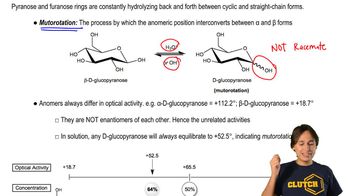
Mutorotation and Optical Activity

Racemization

Racemization is the process by which an optically active compound converts into a racemic mixture, containing equal amounts of both enantiomers. In the case of butan-2-ol, racemization occurs when the chiral center is temporarily converted to a planar carbocation intermediate, allowing for the reformation of the chiral center in either configuration.
추천 영상:
03:59
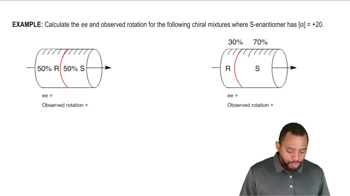
Calculating Enantiomeric Excess and Observed Rotation

Acid-Catalyzed Mechanism

An acid-catalyzed mechanism involves the use of an acid to facilitate a chemical reaction. In the racemization of butan-2-ol, dilute acid protonates the hydroxyl group, converting it into a better leaving group. This leads to the formation of a carbocation, which can then be attacked by a nucleophile from either side, resulting in the formation of both enantiomers.
추천 영상:
06:34
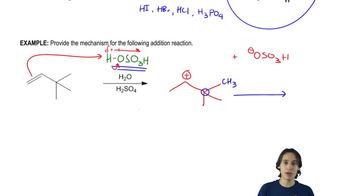
Acid-catalyzed hydration mechanism
관련 실천
교과서 질문

Optically active 2-bromobutane undergoes racemization on treatment with a solution of KBr. Propose a mechanism for this racemization.

1528
views

교과서 질문

Give a mechanism to explain the two products formed in the following reaction.

1084
views
교과서 질문

Using 1,2-dimethylcyclohexene as your starting material, show how you would synthesize the following compounds. (Once you have shown how to synthesize a compound, you may use it as the starting material in any later parts of this problem.) If a chiral product is shown, assume that it is part of a racemic mixture.

(f)

181
views
교과서 질문

In contrast, optically active butan-2-ol does not racemize on treatment with a solution of KOH. Explain why a reaction like that in part (a) does not occur.

1320
views
교과서 질문

Because the SN1 reaction goes through a flat carbocation, we might expect an optically active starting material to give a completely racemized product. In most cases, however, SN1 reactions actually give more of the inversion product. In general, as the stability of the carbocation increases, the excess inversion product decreases. Extremely stable carbocations give completely racemic products. Explain these observations.

1764
views
교과서 질문

a. Optically active 2-bromobutane undergoes racemization on treatment with a solution of KBr. Give a mechanism for this racemization.

b. In contrast, optically active butan-2-ol does not racemize on treatment with a solution of KOH. Explain why a ­reaction like that in part (a) does not occur.

760
views