Ch.6 - Alkyl Halides; Nucleophilic Substitution
Wade - Organic Chemistry 9th Edition
Wade9th EditionOrganic ChemistryISBN: 9780135213728당신이 사용하는 게 아니라요?교과서 변경
6장, 문제 49a

Optically active 2-bromobutane undergoes racemization on treatment with a solution of KBr. Propose a mechanism for this racemization.

검증된 단계별 안내
1
Identify the key concept: Racemization occurs when an optically active compound (one that rotates plane-polarized light) is converted into a racemic mixture (equal amounts of enantiomers, which cancel out optical activity). In this case, the racemization of 2-bromobutane suggests the involvement of a mechanism that allows for the formation of both enantiomers.
Recognize the reaction type: The treatment of 2-bromobutane with KBr suggests a nucleophilic substitution reaction. Since racemization occurs, the mechanism is likely an SN1 reaction, which involves the formation of a planar carbocation intermediate.
Step 1 of the mechanism: The bromide ion (Br⁻) from KBr acts as a leaving group, and the C-Br bond in 2-bromobutane breaks heterolytically. This results in the formation of a planar secondary carbocation at the 2-position of the butane chain. The planar nature of the carbocation allows for attack from either side.
Step 2 of the mechanism: The bromide ion (Br⁻) from the solution acts as a nucleophile and attacks the planar carbocation. Since the carbocation is planar, the bromide ion can attack from either the front or the back, leading to the formation of both the (R)- and (S)-enantiomers of 2-bromobutane.
Explain the outcome: The equal probability of attack from either side of the planar carbocation results in the formation of a racemic mixture (50% (R)-2-bromobutane and 50% (S)-2-bromobutane). This racemic mixture is optically inactive because the optical activities of the two enantiomers cancel each other out.

비슷한 문제에 대한 검증된 영상 답변:

이 영상 해법은 위 문제에 도움이 된다고 튜터들이 추천한 것입니다.
영상 길이:
9m
도움이 되었나요?

주요 개념

질문에 올바르게 답하기 위해 반드시 이해해야 하는 핵심 개념들은 다음과 같습니다.

Optical Activity

Optical activity refers to the ability of a chiral compound to rotate the plane of polarized light. Chiral molecules, which lack an internal plane of symmetry, exist as enantiomers that are non-superimposable mirror images. In the case of 2-bromobutane, its optical activity is due to the presence of a chiral carbon atom, making it important to understand how its configuration can change during reactions.
추천 영상:
08:17
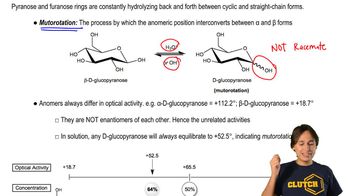
Mutorotation and Optical Activity

Racemization

Racemization is the process by which an optically active compound converts into a racemic mixture, containing equal amounts of both enantiomers. This can occur through various mechanisms, often involving the temporary formation of a planar intermediate that allows for the reformation of both enantiomers. In the case of 2-bromobutane, racemization can occur when the bromine atom is displaced, leading to the formation of both configurations of the molecule.
추천 영상:
03:59
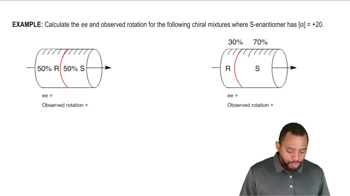
Calculating Enantiomeric Excess and Observed Rotation

Nucleophilic Substitution Mechanism

Nucleophilic substitution is a fundamental reaction mechanism in organic chemistry where a nucleophile attacks an electrophile, resulting in the replacement of a leaving group. In the context of 2-bromobutane and KBr, the bromine atom acts as a leaving group, and the nucleophile (Br-) can attack the chiral center, leading to the formation of both enantiomers. Understanding this mechanism is crucial for proposing how racemization occurs in this reaction.
추천 영상:
01:47
Nucleophiles and Electrophiles can react in Substitution Reactions.