Ch.6 - Alkyl Halides; Nucleophilic Substitution
Wade - Organic Chemistry 9th Edition
Wade9th EditionOrganic ChemistryISBN: 9780135213728당신이 사용하는 게 아니라요?교과서 변경
6장, 문제 49b

In contrast, optically active butan-2-ol does not racemize on treatment with a solution of KOH. Explain why a reaction like that in part (a) does not occur.

검증된 단계별 안내
1
Understand the concept of racemization: Racemization occurs when a chiral molecule converts into a racemic mixture (equal amounts of enantiomers), typically through a reaction that involves the loss of chirality. This often requires the formation of an intermediate that is achiral or planar, allowing for free rotation or attack from either side.
Analyze the structure of butan-2-ol: Butan-2-ol is a secondary alcohol with a chiral center at the second carbon. Its chirality arises from the four different groups attached to this carbon.
Consider the role of KOH: KOH is a strong base, and in the presence of an alcohol, it can deprotonate the hydroxyl group to form an alkoxide ion. However, this does not lead to the loss of chirality because the alkoxide ion retains the tetrahedral geometry around the chiral carbon.
Compare with part (a): In part (a), racemization likely occurred due to the formation of a planar intermediate, such as a carbocation, which allows for attack from either side. However, in the case of butan-2-ol, the reaction with KOH does not involve the formation of a carbocation or any planar intermediate.
Conclude why racemization does not occur: Since the reaction with KOH does not disrupt the tetrahedral geometry of the chiral center in butan-2-ol, the molecule retains its chirality, and no racemization takes place.

비슷한 문제에 대한 검증된 영상 답변:

이 영상 해법은 위 문제에 도움이 된다고 튜터들이 추천한 것입니다.
영상 길이:
4m
도움이 되었나요?

주요 개념

질문에 올바르게 답하기 위해 반드시 이해해야 하는 핵심 개념들은 다음과 같습니다.

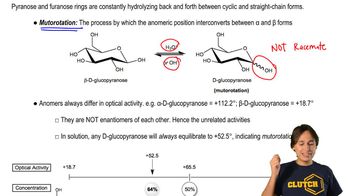
Optical Activity

Optical activity refers to the ability of a chiral compound to rotate the plane of polarized light. This property arises from the presence of a chiral center, which is typically a carbon atom bonded to four different substituents. In the case of butan-2-ol, the presence of a chiral center makes it optically active, meaning it can exist in two enantiomeric forms that rotate light in opposite directions.
추천 영상:
08:17
Mutorotation and Optical Activity

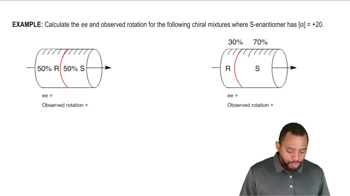
Racemization

Racemization is the process by which an optically active compound converts into a racemic mixture, containing equal amounts of both enantiomers. This typically occurs when the chiral center can be temporarily converted into a prochiral state, allowing for the formation of both enantiomers. In the case of butan-2-ol with KOH, the conditions do not favor racemization, as the reaction does not lead to the necessary transition state for this process.
추천 영상:
03:59
Calculating Enantiomeric Excess and Observed Rotation

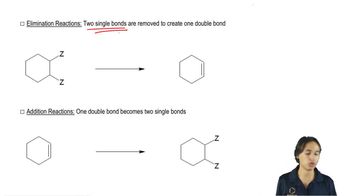
Base-Induced Elimination Reactions

Base-induced elimination reactions, such as those involving KOH, typically lead to the formation of alkenes through the removal of a leaving group and a hydrogen atom. In butan-2-ol, the presence of a strong base like KOH can promote elimination rather than substitution, resulting in the formation of an alkene without racemization. This is because the reaction pathway does not involve the formation of a planar intermediate that would allow for the reformation of both enantiomers.
추천 영상:
00:40
Recognizing Elimination Reactions.