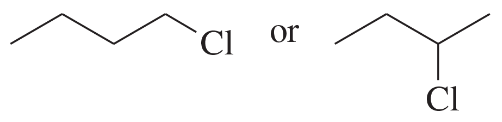
Show how you would convert (in one or two steps) 1-phenylpropane to the three products shown below. In each case, explain what unwanted reactions might produce undesirable impurities in the product.
Ch.6 - Alkyl Halides; Nucleophilic Substitution
6장, 문제 33a,b
Predict the compound in each pair that will undergo the SN2 reaction faster.
(a) 
(b) 
검증된 단계별 안내1
Step 1: Understand the SN2 reaction mechanism. SN2 reactions are bimolecular nucleophilic substitution reactions where the rate depends on both the nucleophile and the substrate. The reaction occurs in a single step with a backside attack, leading to inversion of configuration.
Step 2: Evaluate steric hindrance in the substrates. In SN2 reactions, less sterically hindered substrates react faster because the nucleophile needs access to the electrophilic carbon. Primary alkyl halides are preferred over secondary or tertiary alkyl halides.
Step 3: Analyze the leaving group. A better leaving group facilitates the SN2 reaction. Halides such as I⁻ are better leaving groups than Br⁻, which in turn are better than Cl⁻. This is due to their ability to stabilize the negative charge after leaving.
Step 4: Compare the compounds in pair (a). The first compound has a bromine attached to a tertiary carbon, which is highly sterically hindered, while the second compound has bromine attached to a primary carbon, which is less hindered. The second compound will undergo the SN2 reaction faster.
Step 5: Compare the compounds in pair (b). The first compound has chlorine as the leaving group, while the second compound has iodine. Since iodine is a better leaving group than chlorine, the second compound will undergo the SN2 reaction faster.

비슷한 문제에 대한 검증된 영상 답변:
이 영상 해법은 위 문제에 도움이 된다고 튜터들이 추천한 것입니다.
영상 길이:
3m도움이 되었나요?
주요 개념
질문에 올바르게 답하기 위해 반드시 이해해야 하는 핵심 개념들은 다음과 같습니다.
S<sub>N</sub>2 Reaction Mechanism
The S<sub>N</sub>2 reaction is a bimolecular nucleophilic substitution process where a nucleophile attacks an electrophile, resulting in the simultaneous displacement of a leaving group. This mechanism is characterized by a single concerted step, leading to the inversion of configuration at the carbon center. The rate of the reaction depends on both the concentration of the nucleophile and the substrate.
추천 영상:
Heck Reaction Mechanism
Steric Hindrance
Steric hindrance refers to the prevention of chemical reactions due to the spatial arrangement of atoms within a molecule. In S<sub>N</sub>2 reactions, steric hindrance can significantly affect the reaction rate; less hindered substrates (like primary alkyl halides) react faster than more hindered ones (like tertiary alkyl halides). This is because bulky groups around the reactive center can obstruct the nucleophile's approach.
추천 영상:
Understanding steric effects.
Leaving Group Ability
The ability of a leaving group to depart from a substrate is crucial in determining the rate of S<sub>N</sub>2 reactions. Good leaving groups, such as halides (e.g., Cl<sup>-</sup>, Br<sup>-</sup>), stabilize the transition state and facilitate the reaction. The better the leaving group, the faster the reaction will proceed, as it can more readily dissociate from the substrate during the nucleophilic attack.
추천 영상:
How to use the factors affecting acidity to predict leaving group ability.
관련 실천
교과서 질문
744
views
교과서 질문
Predict the compound in each pair that will undergo solvolysis (in aqueous ethanol) more rapidly.
(c)
(d)
855
views
교과서 질문
Predict the compound in each pair that will undergo solvolysis (in aqueous ethanol) more rapidly.
(a) (CH3CH2)2CH—Cl or (CH3)3C—Cl
(b)
2256
views
교과서 질문
Draw the structures of the following compounds.
a. sec-butyl chloride
b. isobutyl bromide
864
views
교과서 질문
Predict the compound in each pair that will undergo the SN2 reaction faster.
(c)
(d)
1394
views
교과서 질문
Show how you would convert (in one or two steps) 1-phenylpropane to the three products shown below. In each case, explain what unwanted reactions might produce undesirable impurities in the product.
1009
views