Ch.6 - Alkyl Halides; Nucleophilic Substitution
Wade - Organic Chemistry 9th Edition
Wade9th EditionOrganic ChemistryISBN: 9780135213728당신이 사용하는 게 아니라요?교과서 변경
6장, 문제 48b

A solution of pure (S)-2-iodobutane ([α] = +15.90°) in acetone is allowed to react with radioactive iodide, 131I, until 1.0% of the iodobutane contains radioactive iodine. The specific rotation of this recovered iodobutane is found to be +15.58°.
b. What does this result suggest about the mechanism of the reaction of 2-iodobutane with iodide ion?

검증된 단계별 안내
1
Step 1: Begin by understanding the problem. The reaction involves (S)-2-iodobutane reacting with radioactive iodide (131I-) in acetone. The specific rotation of the recovered iodobutane decreases slightly from +15.90° to +15.58°. This suggests that some change has occurred in the stereochemistry of the compound during the reaction.
Step 2: Recall the concept of specific rotation ([α]). Specific rotation is a measure of the optical activity of a chiral compound. A decrease in specific rotation indicates that the optical purity of the compound has been affected, possibly due to the formation of a racemic mixture or partial inversion of configuration.
Step 3: Consider the mechanism of the reaction. The iodide ion (I-) is a nucleophile, and the reaction likely proceeds via an SN2 or SN1 mechanism. In an SN2 reaction, the nucleophile attacks the chiral carbon, leading to inversion of configuration. In an SN1 reaction, the intermediate carbocation can lead to racemization due to attack from either side.
Step 4: Analyze the data. Since only 1.0% of the iodobutane contains radioactive iodine, the majority of the compound remains unchanged. The slight decrease in specific rotation suggests that the reaction mechanism involves partial inversion of configuration, consistent with an SN2 mechanism. This is because SN2 reactions typically result in inversion of stereochemistry at the chiral center.
Step 5: Conclude the analysis. The result suggests that the reaction of 2-iodobutane with iodide ion proceeds primarily via an SN2 mechanism, where the radioactive iodide replaces the original iodine atom with inversion of configuration. The small change in specific rotation indicates that the reaction is not complete and only a small fraction of the molecules undergo inversion.

비슷한 문제에 대한 검증된 영상 답변:

이 영상 해법은 위 문제에 도움이 된다고 튜터들이 추천한 것입니다.
영상 길이:
2m

주요 개념

질문에 올바르게 답하기 위해 반드시 이해해야 하는 핵심 개념들은 다음과 같습니다.

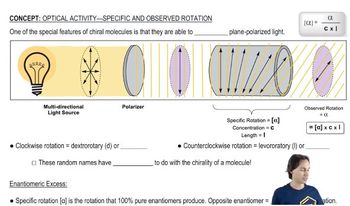
Optical Activity and Specific Rotation

Optical activity refers to the ability of chiral compounds to rotate plane-polarized light. The specific rotation is a quantitative measure of this property, defined as the angle of rotation per unit concentration and path length. In this case, the specific rotation of the pure (S)-2-iodobutane is +15.90°, indicating its chiral nature. The change in specific rotation after the reaction suggests that the product may contain a mixture of chiral centers.
추천 영상:
05:43
Specific rotation vs. observed rotation.

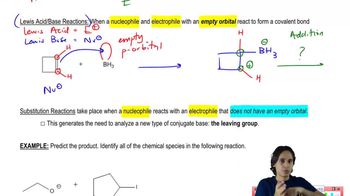
Nucleophilic Substitution Mechanisms

Nucleophilic substitution reactions can occur via two primary mechanisms: SN1 and SN2. The SN1 mechanism involves a two-step process where the leaving group departs first, forming a carbocation intermediate, while the SN2 mechanism is a one-step process where the nucleophile attacks the substrate simultaneously as the leaving group departs. The observed specific rotation change indicates that the reaction likely involves a racemization process, suggesting an SN1 mechanism where the intermediate can lead to both enantiomers.
추천 영상:
01:47
Nucleophiles and Electrophiles can react in Substitution Reactions.

Racemization and Reaction Kinetics

Racemization is the process by which an optically active compound is converted into a racemic mixture, containing equal amounts of both enantiomers. In the context of the reaction, the presence of radioactive iodine in only 1.0% of the product suggests that the reaction did not proceed to completion and that the mechanism allows for the formation of both enantiomers. This observation is crucial for understanding the kinetics and stereochemical outcomes of the reaction involving 2-iodobutane.
추천 영상:
08:51
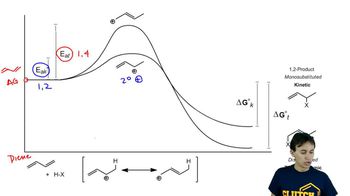
Kinetic vs. Thermodynamic Control
관련 실천
교과서 질문

Optically active 2-bromobutane undergoes racemization on treatment with a solution of KBr. Propose a mechanism for this racemization.

1528
views

교과서 질문

In contrast, optically active butan-2-ol does not racemize on treatment with a solution of KOH. Explain why a reaction like that in part (a) does not occur.

1320
views
교과서 질문

A solution of pure (S)-2-iodobutane ([α] = +15.90°) in acetone is allowed to react with radioactive iodide, 131I, until 1.0% of the iodobutane contains radioactive iodine. The specific rotation of this recovered iodobutane is found to be +15.58°.

a. Determine the percentages of (R)- and (S)-2-iodobutane in the product mixture.

853
views
교과서 질문

Using cyclohexane as one of your starting materials, show how you would synthesize the following compounds.

(e)

1077
views
교과서 질문

a. Optically active 2-bromobutane undergoes racemization on treatment with a solution of KBr. Give a mechanism for this racemization.

b. In contrast, optically active butan-2-ol does not racemize on treatment with a solution of KOH. Explain why a ­reaction like that in part (a) does not occur.

760
views
교과서 질문

Strawberry growers have used large quantities of methyl bromide (b.p. 4 °C) to sterilize the soil before planting their crops. Like some of the freons, methyl bromide can diffuse up into the stratosphere, where it damages the protective ozone layer. Agricultural chemists have suggested using methyl iodide (b.p. 43 °C) as a replacement for methyl bromide. Why is methyl iodide likely to be more toxic to agricultural pests (and people) than methyl bromide? Why is methyl iodide less likely to reach the stratosphere than methyl bromide?

1052
views