
Ch.6 - Alkyl Halides; Nucleophilic Substitution
Wade - Organic Chemistry 9th Edition
Wade9th EditionOrganic ChemistryISBN: 9780135213728당신이 사용하는 게 아니라요?교과서 변경
6장, 문제 17

When diethyl ether (CH3CH2OCH2CH3) is treated with concentrated HBr, the initial products are CH3CH2Br and CH3CH2OH. Propose a mechanism to account for this reaction.

검증된 단계별 안내
1
Step 1: Recognize that diethyl ether (CH3CH2OCH2CH3) is an ether, which is susceptible to cleavage by strong acids like HBr. The reaction begins with protonation of the oxygen atom in the ether by HBr, forming an oxonium ion. This step increases the electrophilicity of the oxygen atom.
Step 2: After protonation, the oxonium ion undergoes cleavage. The bond between the oxygen and one of the ethyl groups breaks, resulting in the formation of an alcohol (CH3CH2OH) and a carbocation (CH3CH2+). This step is facilitated by the stability of the carbocation formed.
Step 3: The carbocation (CH3CH2+) formed in the previous step reacts with the bromide ion (Br−) from HBr to form ethyl bromide (CH3CH2Br). This is a nucleophilic substitution reaction where the bromide ion attacks the carbocation.
Step 4: The products of the reaction are CH3CH2Br (ethyl bromide) and CH3CH2OH (ethanol). The mechanism involves protonation, cleavage of the ether bond, and nucleophilic attack by bromide.
Step 5: Note that the reaction proceeds via an SN1 mechanism due to the formation of a carbocation intermediate. The stability of the carbocation is crucial for the reaction to proceed efficiently.

비슷한 문제에 대한 검증된 영상 답변:

이 영상 해법은 위 문제에 도움이 된다고 튜터들이 추천한 것입니다.
영상 길이:
6m
도움이 되었나요?

주요 개념

질문에 올바르게 답하기 위해 반드시 이해해야 하는 핵심 개념들은 다음과 같습니다.

Ether Cleavage

Ether cleavage is a reaction where ethers are broken down into alcohols and alkyl halides, typically in the presence of strong acids like HBr. The mechanism involves protonation of the ether oxygen, making it a better leaving group, followed by nucleophilic attack by bromide ions, leading to the formation of alkyl bromides and alcohols.
추천 영상:
가이드 코스
1:45
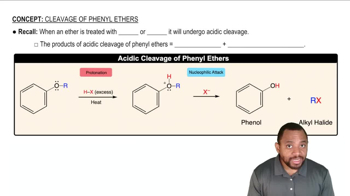
Cleavage of Phenyl Ethers Concept 1

Nucleophilic Substitution Mechanisms

Nucleophilic substitution mechanisms, such as SN1 and SN2, describe how nucleophiles replace leaving groups in organic molecules. In the case of diethyl ether with HBr, the reaction likely follows an SN2 mechanism, where the bromide ion attacks the carbon bonded to the ether oxygen, resulting in the formation of bromoethane and ethanol.
추천 영상:
01:47
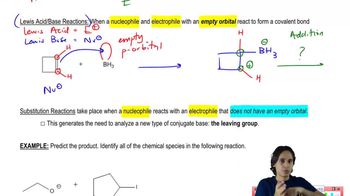
Nucleophiles and Electrophiles can react in Substitution Reactions.

Protonation of Ethers

Protonation of ethers occurs when an ether oxygen atom is protonated by an acid, increasing the electrophilicity of the adjacent carbon atoms. This step is crucial in ether cleavage, as it facilitates the formation of a more reactive intermediate that can undergo nucleophilic attack, ultimately leading to the cleavage of the ether bond.
추천 영상:
04:22
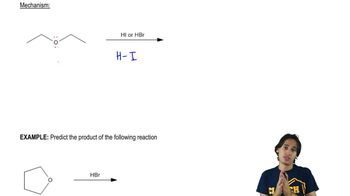
How to predict the products of Ether Cleavage.