Ch.6 - Alkyl Halides; Nucleophilic Substitution
Wade - Organic Chemistry 9th Edition
Wade9th EditionOrganic ChemistryISBN: 9780135213728당신이 사용하는 게 아니라요?교과서 변경
6장, 문제 16c,d

For each pair, predict the stronger nucleophile in the SN2 reaction (using an alcohol as the solvent). Explain your prediction.
c. NH3 or PH3
d. CH3S or H2S

검증된 단계별 안내
1
Understand the concept of nucleophilicity: Nucleophilicity refers to the ability of a species to donate a pair of electrons to an electrophile. In SN2 reactions, stronger nucleophiles react faster. Factors affecting nucleophilicity include charge, electronegativity, solvent effects, and the size of the nucleophile.
Analyze the solvent: The problem specifies that the solvent is an alcohol, which is a polar protic solvent. Polar protic solvents can hydrogen bond with nucleophiles, stabilizing them and reducing their nucleophilicity. Larger, less electronegative atoms are less affected by this stabilization, making them stronger nucleophiles in polar protic solvents.
Compare NH3 and PH3: Nitrogen (N) is smaller and more electronegative than phosphorus (P). In a polar protic solvent, NH3 will be more stabilized by hydrogen bonding than PH3. Since PH3 is less stabilized, it will be the stronger nucleophile in this solvent.
Compare CH3S⁻ and H2S: CH3S⁻ is negatively charged, while H2S is neutral. Negatively charged species are generally stronger nucleophiles than their neutral counterparts. Additionally, sulfur (S) is larger and less electronegative than oxygen, so CH3S⁻ will be less stabilized by the polar protic solvent compared to H2S, making CH3S⁻ the stronger nucleophile.
Summarize the predictions: For part (c), PH3 is the stronger nucleophile in an alcohol solvent. For part (d), CH3S⁻ is the stronger nucleophile due to its negative charge and reduced stabilization in the polar protic solvent.

비슷한 문제에 대한 검증된 영상 답변:

이 영상 해법은 위 문제에 도움이 된다고 튜터들이 추천한 것입니다.
영상 길이:
5m
도움이 되었나요?

주요 개념

질문에 올바르게 답하기 위해 반드시 이해해야 하는 핵심 개념들은 다음과 같습니다.

Nucleophilicity

Nucleophilicity refers to the ability of a species to donate an electron pair to an electrophile during a chemical reaction. In SN2 reactions, stronger nucleophiles are typically negatively charged or have lone pairs that can readily participate in bond formation. Factors influencing nucleophilicity include charge, electronegativity, and solvent effects, with polar protic solvents often stabilizing nucleophiles and reducing their reactivity.
추천 영상:
08:27
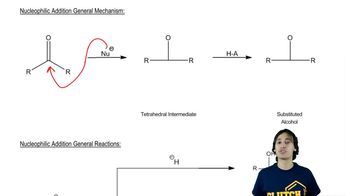
Nucleophilic Addition

SN2 Mechanism

The SN2 (substitution nucleophilic bimolecular) mechanism involves a single concerted step where the nucleophile attacks the electrophile, leading to the displacement of a leaving group. This reaction is characterized by a backside attack, resulting in inversion of configuration at the carbon center. The rate of the reaction depends on the concentration of both the nucleophile and the substrate, making it bimolecular.
추천 영상:
08:33
Drawing the SN2 Mechanism

Solvent Effects

The choice of solvent can significantly influence the nucleophilicity of reactants in an SN2 reaction. In polar protic solvents, such as alcohols, nucleophiles can be stabilized through hydrogen bonding, which can hinder their reactivity. Conversely, polar aprotic solvents do not solvate anions as effectively, often leading to increased nucleophilicity. Understanding how solvents interact with nucleophiles is crucial for predicting reaction outcomes.
추천 영상:
01:16
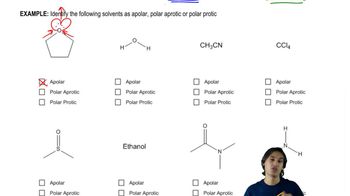
Identification of polarity in solvents