뒤로
뒤로
문제 40b
Two small metal cubes with masses 2.0 g and 4.0 g are tied together by a 5.0-cm-long massless string and are at rest on a frictionless surface. Each is charged to +2.0 μC. What is the tension in the string?
문제 41
A −3.0 nC charge is on the x-axis at x=−9 cm and a +4.0 nC charge is on the x-axis at x=16 cm. At what point or points on the y-axis is the electric potential zero?
문제 42
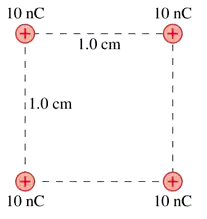
The four 1.0 g spheres shown in FIGURE P25.42 are released simultaneously and allowed to move away from each other. What is the speed of each sphere when they are very far apart?
문제 43
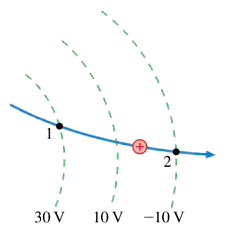
A proton's speed as it passes point 1 is 50,000 m/s. It follows the trajectory shown in FIGURE P25.43. What is the proton's speed at point 2?
문제 44b
Living cells 'pump' singly ionized sodium ions, Na+, from the inside of the cell to the outside to maintain a membrane potential ΔVmembrane=Vin−Vout=−70 mV. It is called pumping because work must be done to move a positive ion from the negative inside of the cell to the positive outside, and it must go on continuously because sodium ions 'leak' back through the cell wall by diffusion. At rest, the human body uses energy at the rate of approximately 100 W to maintain basic metabolic functions. It has been estimated that 20% of this energy is used to operate the sodium pumps of the body. Estimate—to one significant figure—the number of sodium ions pumped per second.
문제 45
An arrangement of source charges produces the electric potential V=5000x2 along the x-axis, where V is in volts and x is in meters. What is the maximum speed of a 1.0 g, 10 nC charged particle that moves in this potential with turning points at ±8.0 cm?
문제 46b
The electron gun in an old TV picture tube accelerates electrons between two parallel plates 1.2 cm apart with a 25 kV potential difference between them. The electrons enter through a small hole in the negative plate, accelerate, then exit through a small hole in the positive plate. Assume that the holes are small enough not to affect the electric field or potential. With what speed does an electron exit the electron gun if its entry speed is close to zero?
문제 48a
A room with 3.0-m-high ceilings has a metal plate on the floor with V=0 V and a separate metal plate on the ceiling. A 1.0 g glass ball charged to +4.9 nC is shot straight up at 5.0 m/s. How high does the ball go if the ceiling voltage is +3.0×10⁶ V?
문제 49
A 0.25 pg dust particle with 50 excess electrons is sitting at rest on top of a 5.0-cm-diameter metal sphere. Closing a switch charges the sphere almost instantaneously. To what potential must the sphere be charged to launch the dust particle to a height of 5.0 m? Ignore air resistance.
문제 50b
The electric potential in a region of space is given by V=V₀[(x²+2y²)/(0.10 m)²], where V₀ is a constant. A proton released from rest at (x, y)=(20 cm, 0 cm) reaches the origin with a speed of 7.5×10⁵ m/s. At what value of y on the y-axis should a He+ ion (charge +e, mass 4 u) be released from rest to reach the origin with the same speed?
문제 51
What is the escape speed of an electron launched from the surface of a 1.0-cm-diameter glass sphere that has been charged to 10 nC?
문제 53
Three electrons form an equilateral triangle 1.0 nm on each side. A proton is at the center of the triangle. What is the potential energy of this group of charges?
문제 55
A 2.0-mm-diameter glass bead is positively charged. The potential difference between a point 2.0 mm from the bead and a point 4.0 mm from the bead is 500 V. What is the charge on the bead?
문제 56
A proton is fired from far away toward the nucleus of an iron atom. Iron is element number 26, and the diameter of the nucleus is 9.0 fm. What initial speed does the proton need to just reach the surface of the nucleus? Assume the nucleus remains at rest.
문제 57
In the form of radioactive decay known as alpha decay, an unstable nucleus emits a helium-atom nucleus, which is called an alpha particle. An alpha particle contains two protons and two neutrons, thus having mass m=4 u and charge q=2e. Suppose a uranium nucleus with 92 protons decays into thorium, with 90 protons, and an alpha particle. The alpha particle is initially at rest at the surface of the thorium nucleus, which is 15 fm in diameter. What is the speed of the alpha particle when it is detected in the laboratory? Assume the thorium nucleus remains at rest.
문제 59
A 2.0-cm-diameter copper ring has 5.0×10⁹ excess electrons. A proton is released from rest on the axis of the ring, 5.0 cm from its center. What is the proton's speed as it passes through the center of the ring?
문제 60c
Two 10-cm-diameter electrodes 0.50 cm apart form a parallel-plate capacitor. The electrodes are attached by metal wires to the terminals of a 15 V battery. After a long time, the capacitor is disconnected from the battery but is not discharged. What are the charge on each electrode, the electric field strength inside the capacitor, and the potential difference between the electrodes after the original electrodes (not the modified electrodes of part b) are expanded until they are 20 cm in diameter?
문제 62a
Electrodes of area A are spaced distance d apart to form a parallel-plate capacitor. The electrodes are charged to ±q. What is the infinitesimal increase in electric potential energy dU if an infinitesimal amount of charge dq is moved from the negative electrode to the positive electrode?
문제 64a
The potential 1.0 cm from the surface of a metal sphere is 8000 V. The potential 3.0 cm from the surface is 4000 V. What is the radius of the sphere?
문제 65
Two spherical drops of mercury each have a charge of 0.10 nC and a potential of 300 V at the surface. The two drops merge to form a single drop. What is the potential at the surface of the new drop?
문제 66b
A Van de Graaff generator is a device for generating a large electric potential by building up charge on a hollow metal sphere. A typical classroom-demonstration model has a diameter of 30 cm. What is the electric field strength just outside the surface of the sphere when it is charged to 500,000 V?
문제 67
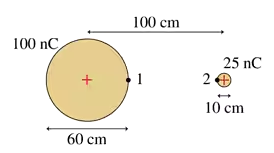
FIGURE P25.67 shows two uniformly charged spheres. What is the potential difference between points 1 and 2? Which point is at the higher potential? Hint: The potential at any point is the superposition of the potentials due to all charges.
문제 68
Two metal objects that are in contact must be at the same potential, an assertion we'll prove in the next chapter. Suppose a metal sphere of radius R is charged to 1000 V and a second metal sphere of radius 2R is charged to 2000 V. The two spheres are brought into contact and then separated. Afterward, what is the potential of each sphere?
문제 70
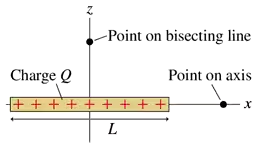
FIGURE P25.70 shows a thin rod of length L and charge Q. Find an expression for the electric potential a distance x away from the center of the rod on the axis of the rod.
문제 72
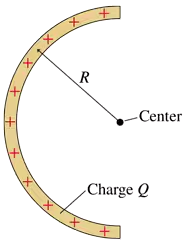
FIGURE P25.72 shows a thin rod with charge Q that has been bent into a semicircle of radius R. Find an expression for the electric potential at the center.
문제 74
The wire in FIGURE P25.74 has linear charge density λ. What is the electric potential at the center of the semicircle?
문제 75b
You are given the equation(s) used to solve a problem. Finish the solution of the problem: (9.0×10⁹ Nm2/C2)q₁q₂/0.030 m =90×10−6 J; q₁+q₂=40 nC.
문제 78
An electric dipole consists of 1.0 g spheres charged to ±2.0 nC at the ends of a 10-cm-long massless rod. The dipole rotates on a frictionless pivot at its center. The dipole is held perpendicular to a uniform electric field with field strength 1000 V/m, then released. What is the dipole's angular velocity at the instant it is aligned with the electric field?
문제 80
Bead A has a mass of 15 g and a charge of −5.0 nC. Bead B has a mass of 25 g and a charge of −10.0 nC. The beads are held 12 cm apart (measured between their centers) and released. What maximum speed is achieved by each bead?
문제 81
Two 2.0-mm-diameter beads, C and D, are 10 mm apart, measured between their centers. Bead C has mass 1.0 g and charge 2.0 nC. Bead D has mass 2.0 g and charge −1.0 nC. If the beads are released from rest, what are the speeds vC and vD at the instant the beads collide?