Back

Horizontal Disease Transmission definitions

Control buttons has been changed to "navigation" mode.
1/15
  • Horizontal Transmission

    Transfer of pathogens between individuals in the same generation, involving direct or indirect pathways, not from parent to offspring.
  • Direct Contact

    Physical interaction with a reservoir, such as touching or shaking hands, enabling immediate pathogen transfer to a host.
  • Droplet Transmission

    Spread of pathogens via large respiratory droplets expelled by sneezing, coughing, or talking, requiring close proximity.
  • Reservoir

    Source or habitat where a pathogen normally lives and multiplies, serving as the origin for infection.
  • Portal of Entry

    Site on a susceptible host where a pathogen gains access, such as the eye, mouth, or skin.
  • Indirect Transmission

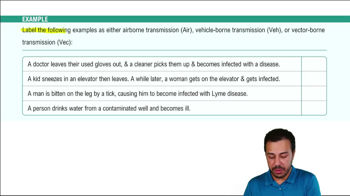
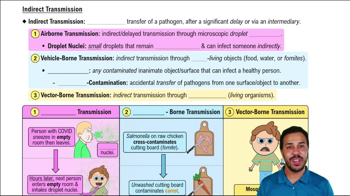
    Pathogen transfer involving an intermediary, such as air, objects, or living vectors, often with a delay.
  • Airborne Transmission

    Spread of pathogens through microscopic droplet nuclei that remain suspended in air, enabling long-distance infection.
  • Droplet Nuclei

    Tiny, airborne particles containing pathogens that can remain suspended for extended periods and travel far.
  • Vehicle-Borne Transmission

    Pathogen spread via nonliving objects like food, water, or fomites acting as intermediaries.
  • Fomite

    Any contaminated inanimate object or surface capable of transmitting infectious agents to a host.
  • Cross Contamination

    Accidental transfer of pathogens from one object or surface to another, creating new vehicles for infection.
  • Vector-Borne Transmission

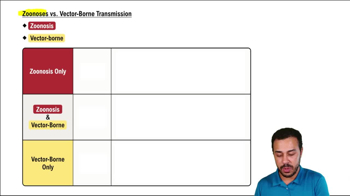
    Spread of pathogens through living organisms, typically arthropods, that act as intermediaries between reservoir and host.
  • Mechanical Vector

    Living organism that passively transports pathogens without internal replication, simply carrying them from one place to another.
  • Biological Vector

    Living organism in which a pathogen replicates before being transmitted to a host, often essential for the pathogen's life cycle.
  • Zoonosis

    Infectious disease originating from a nonhuman animal reservoir, capable of being transmitted to humans.