Back

Horizontal Disease Transmission quiz

Control buttons has been changed to "navigation" mode.
1/15
  • What are the two main types of horizontal disease transmission?

    The two main types are direct transmission and indirect transmission.
  • How does direct contact transmission occur?

    Direct contact transmission occurs when there is physical contact between the reservoir and the susceptible host, such as touching or shaking hands.
  • What is the most effective way to reduce the risk of direct contact transmission?

    Frequent and thorough hand washing is the most effective way to reduce direct contact transmission.
  • How are pathogens transferred in droplet transmission?

    Pathogens are transferred via large respiratory droplets expelled when an infected person sneezes, coughs, or talks.
  • Why do respiratory droplets in droplet transmission require close proximity?

    Because the droplets are large and fall to the ground quickly, close proximity is needed for them to reach another person.
  • What distinguishes airborne transmission from droplet transmission?

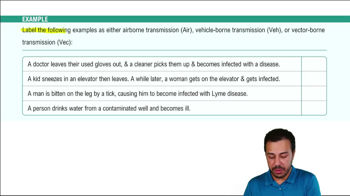
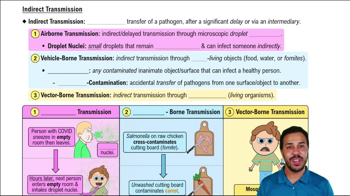
    Airborne transmission involves microscopic droplet nuclei that remain suspended in the air for long periods, unlike large droplets in droplet transmission.
  • How can airborne transmission infect someone indirectly?

    A person can inhale droplet nuclei left in the air by an infected individual, even hours after the infected person has left.
  • What is vehicle-borne transmission?

    Vehicle-borne transmission is the indirect transfer of pathogens via nonliving objects like food, water, or fomites.
  • What is a fomite?

    A fomite is any contaminated inanimate object or surface that can transmit pathogens to a healthy person.
  • What is cross contamination in the context of vehicle-borne transmission?

    Cross contamination is the accidental transfer of pathogens from one surface or object to another, creating new vehicles for transmission.
  • What is vector-borne transmission?

    Vector-borne transmission is the indirect transfer of pathogens via living organisms, such as insects, that act as intermediaries.
  • What is the difference between mechanical and biological vectors?

    Mechanical vectors passively transport pathogens without replication, while biological vectors allow pathogens to replicate inside them.
  • How does a mechanical vector transmit disease?

    A mechanical vector, like a fly, picks up pathogens from one location and transfers them to another without the pathogen replicating inside the vector.
  • How does a biological vector transmit disease?

    A biological vector, such as a mosquito, allows the pathogen to replicate inside it before transmitting it to a susceptible host.
  • What is the main difference between zoonoses and vector-borne transmission?

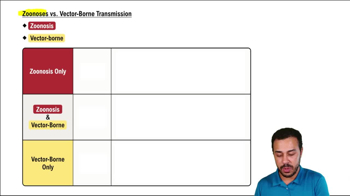
    Zoonoses refer to diseases originating from nonhuman animal reservoirs, while vector-borne transmission describes how diseases spread via living vectors.