Back
Back
Problem 1
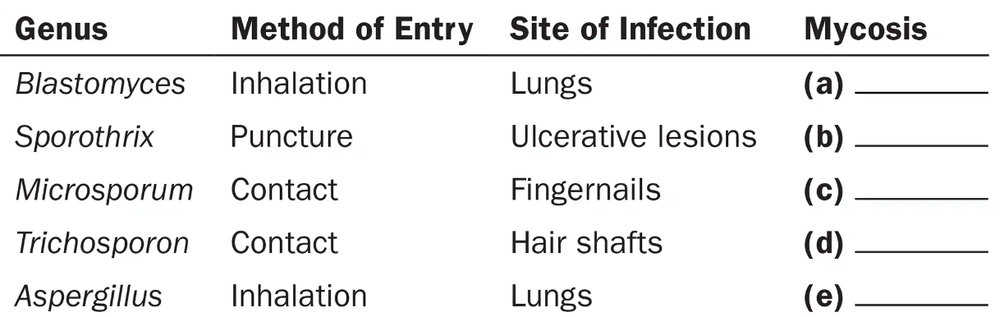
Following is a list of fungi, their methods of entry into the body, and sites of infections they cause. Categorize each type of mycosis as cutaneous, opportunistic, subcutaneous, superficial, or systemic.
Problem 2
A mixed culture of Escherichia coli and Penicillium chrysogenum is inoculated onto the following culture media. On which medium would you expect each to grow? Why?
a. 0.5% peptone in tap water
b. 10% glucose in tap water
Problem 3
Identify the structures of this eukaryote, which has an affinity for keratin.
<IMAGE>
Problem 4
Briefly discuss the importance of lichens in nature. Briefly discuss the importance of algae in nature.
Problem 5
Differentiate cellular and plasmodial slime molds. How does each survive adverse environmental conditions?
Problem 6
Complete the following table.
Problem 7
Why is it significant that Trichomonas does not have a cyst stage? Name a protozoan parasite that does have a cyst stage.
Problem 8
By what means are helminthic parasites transmitted to humans?
Problem 9
Most roundworms are dioecious. What does this term mean? To what phylum do roundworms belong?
Problem 1
How many phyla are represented in the following list of organisms: Echinococcus, Cyclospora, Aspergillus, Taenia, Toxoplasma, Trichinella?
a. 1
b. 2
c. 3
d. 4
e. 5
Problem 2
Use the following choices to answer the following question:
1. Metacercaria
2. Redia
3. Adult
4. Miracidium
5. Cercaria
Put the preceding stages in order of development, beginning with the egg.
a. 5, 4, 1, 2, 3
b. 4, 2, 5, 1, 3
c. 2, 5, 4, 3, 1
d. 3, 4, 5, 1, 2
e. 2, 4, 5, 1, 3
Problem 3
Use the following choices to answer questions 2 and 3:
1. metacercaria
2. redia
3. adult
4. miracidium
5. cercaria
If a snail is the first intermediate host of a parasite with these stages, which stage would be found in the snail?
a. 1
b. 2
c. 3
d. 4
e. 5
Problem 5
Which of the following statements about yeasts are true?
Problem 6
Which of the following events follows cell fusion in an ascomycete?
a. Conidiophore formation
b. Conidiospore germination
c. Ascus opening
d. Ascospore formation
e. Conidiospore release
Problem 7
The definitive host for Plasmodium vivax is
a. Human
b. Anopheles
c. A sporocyte
d. A gametocyte
Problem 8
Use the following choices to answer questions 8–10:
a. Apicomplexa
b. ciliates
c. dinoflagellates
d. Microsporidia
These are obligate intracellular parasites that lack mitochondria.
Problem 10
Which of the following neurotoxins are released by some species of dinoflagellates to protect themselves from predators?
a) Tetrodotoxin
b) Botulinum toxin
c) Maitotoxin
d) Ricin