Given the following Keq values, how much stronger of a base is acetate (CH3CO2-) than chloride (Cl⁻)?
Ch. 4 - Acids and Bases: Electron Flow

Mullins1st EditionOrganic Chemistry: A Learner Centered ApproachISBN: 9780137566471Not the one you use?Change textbook
Chapter 3, Problem 26
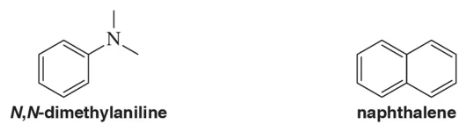
Design an acid–base extraction scheme to separate a mixture of the basic amine N,N-dimethylaniline and naphthalene.

Verified step by step guidance1
Step 1: Recognize the chemical properties of the compounds. N,N-dimethylaniline is a basic amine due to the nitrogen atom with lone pairs, which can accept protons. Naphthalene is a neutral aromatic hydrocarbon and does not react with acids or bases under normal conditions.
Step 2: Add the mixture of N,N-dimethylaniline and naphthalene to an organic solvent, such as diethyl ether or dichloromethane, to dissolve both compounds.
Step 3: Perform an acid extraction by adding an aqueous solution of a strong acid, such as hydrochloric acid (HCl). The acid will protonate the basic amine (N,N-dimethylaniline), converting it into its water-soluble ionic form (N,N-dimethylaniline hydrochloride), while naphthalene remains in the organic layer.
Step 4: Separate the two layers using a separatory funnel. The aqueous layer will contain the protonated N,N-dimethylaniline, and the organic layer will contain naphthalene.
Step 5: Recover N,N-dimethylaniline by neutralizing the aqueous layer with a base, such as sodium hydroxide (NaOH). This will regenerate the free amine, which can then be extracted back into an organic solvent. Evaporate the solvent to isolate N,N-dimethylaniline, and evaporate the organic layer to isolate naphthalene.

Verified video answer for a similar problem:
This video solution was recommended by our tutors as helpful for the problem above.
Was this helpful?
Key Concepts
Here are the essential concepts you must grasp in order to answer the question correctly.
Acid-Base Extraction
Acid-base extraction is a technique used to separate compounds based on their acid-base properties. In this process, a mixture is treated with an acid or base to convert one or more components into their ionic forms, which are more soluble in water. This allows for the selective removal of either acidic or basic compounds from the mixture, facilitating their separation.
Recommended video:
Guided course
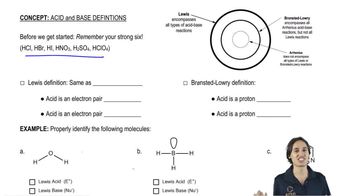
The Lewis definition of acids and bases.
N,N-Dimethylaniline
N,N-Dimethylaniline is a basic amine with the chemical formula C8H11N. It contains a nitrogen atom bonded to two methyl groups and an aniline group, making it a weak base. Its basicity allows it to react with acids to form water-soluble salts, which can be exploited in an acid-base extraction to separate it from non-polar compounds like naphthalene.
Recommended video:
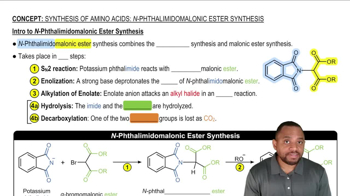
Synthesis of Amino Acids: N-Phthalimidomalonic Ester Synthesis Concept 1
Naphthalene
Naphthalene is a polycyclic aromatic hydrocarbon consisting of two fused benzene rings, with the formula C10H8. It is a non-polar compound that is insoluble in water but soluble in organic solvents. In an acid-base extraction, naphthalene remains in the organic layer while the basic amine can be converted to its salt form and extracted into the aqueous layer, allowing for effective separation.
Related Practice
Textbook Question
1055
views
Textbook Question
Given the following Keq values, how much stronger of an acid is methanol (CH3OH) than acetylene (HC≡CH)?
1126
views
Textbook Question
Given the Keq values for the following acid–base reactions, identify the strongest acid and the strongest base.
(c)
1003
views
Textbook Question
An unknown acid (HA) has been identified as very strong. What does this tell you about the stability of the conjugate base, A⁻? Is it strong or weak? Is it reactive or unreactive?
1100
views
Textbook Question
Given that the indicated pKa values correspond to the acid dissociation reactions shown, calculate the ratio of acid to conjugate base for the reactions shown.
(a)
925
views
Textbook Question
An unknown base (B⁻) has been identified as very weak. What does this tell you about the strength of its conjugate acid, HB? Is it stable or unstable? Is it reactive or unreactive?
844
views