Ch. 20 - The Organic Chemistry of Carbohydrates
Bruice - Organic Chemistry 8th Edition
Bruice8th EditionOrganic ChemistryISBN: 9780135213711Not the one you use?Change textbook
Chapter 21, Problem 31d

What is the main structural difference between d. cellulose and chitin?

Verified step by step guidance
1
Cellulose and chitin are both polysaccharides, meaning they are composed of long chains of monosaccharide units linked by glycosidic bonds. Begin by understanding the basic structure of polysaccharides.
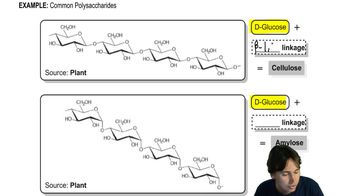
Cellulose is composed of β-D-glucose monomers linked by β(1→4) glycosidic bonds. This structure forms linear chains that can hydrogen bond with adjacent chains, creating a strong, fibrous material.
Chitin, on the other hand, is composed of N-acetylglucosamine monomers, which are glucose molecules modified with an acetyl group attached to the nitrogen atom. These monomers are also linked by β(1→4) glycosidic bonds.
The main structural difference between cellulose and chitin lies in the functional group attached to the glucose monomers. Cellulose has hydroxyl (-OH) groups, while chitin has N-acetyl groups (-NHCOCH₃) on the second carbon of each monomer.
This difference in functional groups gives chitin additional properties, such as increased rigidity and resistance to degradation, making it suitable for structural roles in organisms like arthropods and fungi.

Verified video answer for a similar problem:

This video solution was recommended by our tutors as helpful for the problem above.
Video duration:
6m
Was this helpful?

Key Concepts

Here are the essential concepts you must grasp in order to answer the question correctly.

Polysaccharide Structure

Polysaccharides are large carbohydrate molecules composed of long chains of monosaccharide units. The structural differences between polysaccharides like cellulose and chitin arise from the types of monosaccharides involved and their glycosidic linkages. Understanding these structures is crucial for distinguishing their properties and functions in biological systems.
Recommended video:
Guided course
11:53
Polysaccharide

Cellulose

Cellulose is a polysaccharide made up of β-glucose units linked by β-1,4-glycosidic bonds. This arrangement allows for the formation of strong, linear chains that can hydrogen bond with each other, providing structural support in plant cell walls. The rigidity and insolubility of cellulose are key to its role in maintaining plant structure.
Recommended video:
Guided course
11:53
Polysaccharide

Chitin

Chitin is a polysaccharide composed of N-acetylglucosamine units linked by β-1,4-glycosidic bonds, similar to cellulose but with an amine group. This structural difference contributes to the toughness and flexibility of chitin, making it a critical component of the exoskeletons of arthropods and the cell walls of fungi. Chitin's unique properties are essential for its biological functions.