Ch. 8 - Alkenes I: Properties and Electrophilic Additions
Mullins - Organic Chemistry: A Learner Centered Approach 1st Edition
Mullins1st EditionOrganic Chemistry: A Learner Centered ApproachISBN: 9780137566471Not the one you use?Change textbook
Chapter 7, Problem 15b

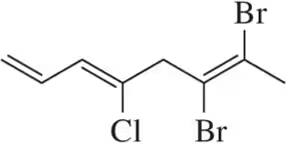
Name the following alkenes.
(b) Chemical structure of an alkene with chlorine and bromine substituents, illustrating cis and trans isomerism.

Verified step by step guidance
1
Step 1: Identify the longest continuous carbon chain that contains the double bond. This will serve as the parent chain and determine the base name of the alkene.
Step 2: Number the carbon atoms in the parent chain starting from the end closest to the double bond. This ensures the double bond gets the lowest possible number.
Step 3: Locate the position of the double bond and include its number in the name. For example, if the double bond starts at carbon 2, the name will include '2-ene'.
Step 4: Identify and name any substituents (side groups) attached to the parent chain. Use prefixes like 'methyl-', 'ethyl-', etc., and assign their positions based on the numbering of the parent chain.
Step 5: Combine the substituent names, the position of the double bond, and the parent chain name into the final IUPAC name, ensuring proper alphabetical order for substituents and correct placement of numbers.

Verified video answer for a similar problem:

This video solution was recommended by our tutors as helpful for the problem above.
Video duration:
2m
Was this helpful?

Key Concepts

Here are the essential concepts you must grasp in order to answer the question correctly.

Alkenes

Alkenes are hydrocarbons that contain at least one carbon-carbon double bond (C=C). They are unsaturated compounds, meaning they have fewer hydrogen atoms than alkanes, which are saturated. The presence of the double bond gives alkenes unique reactivity and isomerism, making them important in organic synthesis and industrial applications.
Recommended video:
2:09
Alkene Metathesis Concept 1

Nomenclature

Nomenclature in organic chemistry refers to the systematic naming of chemical compounds based on established rules. For alkenes, the IUPAC naming convention involves identifying the longest carbon chain containing the double bond, numbering the chain to give the double bond the lowest possible number, and using suffixes like '-ene' to indicate the presence of the double bond.
Recommended video:
4:02
Nomenclature of Heterocycles Concept 2

Geometric Isomerism

Geometric isomerism, also known as cis-trans isomerism, occurs in alkenes due to the restricted rotation around the carbon-carbon double bond. This leads to different spatial arrangements of substituents attached to the double-bonded carbons. Understanding geometric isomerism is crucial for naming alkenes accurately, as it affects their physical and chemical properties.
Recommended video:
Guided course
06:47
Monosaccharides - D and L Isomerism