Ch. 1 - Remembering General Chemistry: Electronic Structure and Bonding (Part 1)
Bruice - Organic Chemistry 8th Edition
Bruice8th EditionOrganic ChemistryISBN: 9780135213711Not the one you use?Change textbook
Chapter 1, Problem 25

Predict whether He2+ exists.

Verified step by step guidance
1
Step 1: Understand the molecular orbital (MO) theory, which is used to predict the existence and stability of diatomic molecules. According to MO theory, the bonding and antibonding molecular orbitals are formed by the combination of atomic orbitals.
Step 2: Write the electronic configuration of helium (He). Helium has an atomic number of 2, so its electronic configuration is 1s². For He2+, one electron is removed, leaving a total of 3 electrons to distribute in molecular orbitals.
Step 3: Construct the molecular orbital diagram for He2+. The 1s orbitals of each helium atom combine to form a bonding molecular orbital (σ1s) and an antibonding molecular orbital (σ1s*).
Step 4: Fill the molecular orbitals with the 3 electrons, starting with the lowest energy orbital (σ1s). Place 2 electrons in the σ1s orbital and 1 electron in the σ1s* orbital, following the Aufbau principle and Hund's rule.
Step 5: Calculate the bond order using the formula: Bond Order = (Number of electrons in bonding orbitals - Number of electrons in antibonding orbitals) / 2. Use this bond order to determine whether He2+ is stable and can exist.

Verified video answer for a similar problem:

This video solution was recommended by our tutors as helpful for the problem above.
Video duration:
3m
Was this helpful?

Key Concepts

Here are the essential concepts you must grasp in order to answer the question correctly.

Ionization Energy

Ionization energy is the energy required to remove an electron from an atom or ion. For helium, which has a high ionization energy due to its small size and effective nuclear charge, removing an electron to form He<sup>2+</sup> would require a significant amount of energy. This high energy requirement makes the formation of He<sup>2+</sup> less favorable.
Recommended video:
Guided course
04:28
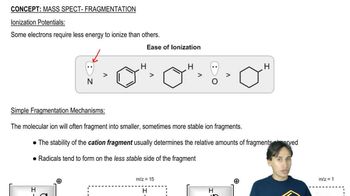
Ionization Potentials

Stability of Ions

The stability of ions is influenced by factors such as electron configuration and the effective nuclear charge. Helium, with its complete electron shell (1s<sup>2</sup>), is already in a stable state. The removal of both electrons to form He<sup>2+</sup> would lead to a highly unstable ion, as it would have no electrons to shield the nucleus, making it unlikely to exist.
Recommended video:
3:39
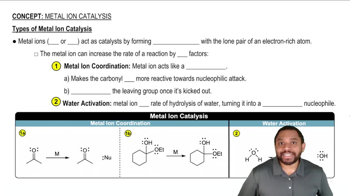
Metal Ion Catalysis Concept 1

Quantum Mechanics and Electron Configuration

Quantum mechanics governs the behavior of electrons in atoms, including their arrangement and energy levels. Helium's electron configuration is 1s<sup>2</sup>, indicating two electrons in the lowest energy level. The principles of quantum mechanics suggest that removing both electrons would not only destabilize the atom but also violate the Pauli exclusion principle, further supporting the conclusion that He<sup>2+</sup> is unlikely to exist.
Recommended video:
Guided course
04:12
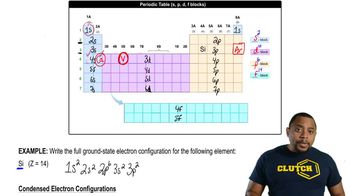
The Electron Configuration