

Ch. 16 - Reactions of Aldehydes and Ketones • More Reactions of Carboxylic Acid Derivatives
Bruice - Organic Chemistry 8th Edition
Bruice8th EditionOrganic ChemistryISBN: 9780135213711Not the one you use?Change textbook
Chapter 17, Problem 90

Identify compounds A and B:

Verified step by step guidance
1
Step 1: Analyze the first reaction. The compound X reacts with a Gilman reagent (R2CuLi), which is known for performing conjugate addition to α,β-unsaturated carbonyl compounds. This suggests that X is likely an α,β-unsaturated ketone or aldehyde.
Step 2: The Gilman reagent adds one of its alkyl groups to the β-carbon of the α,β-unsaturated system in X. This results in compound Y, which is a substituted ketone or aldehyde. The reaction is followed by acidic workup (H3O+), ensuring the stability of the product.
Step 3: Analyze the second reaction. Compound Y reacts with an organometallic reagent, specifically a Grignard reagent (R-MgBr). Grignard reagents typically add to the carbonyl group of ketones or aldehydes, forming an alcohol after acidic workup.
Step 4: The Grignard reagent adds its alkyl group to the carbonyl carbon of Y, forming a tertiary alcohol after the acidic workup. The final product is a tertiary alcohol with a cyclohexane ring and multiple substituents.
Step 5: Based on the structure of the final product provided in the image, deduce the structures of compounds X and Y by working backward. Compound X is likely an α,β-unsaturated ketone, and compound Y is the intermediate ketone formed after the conjugate addition of the Gilman reagent.

Verified video answer for a similar problem:

This video solution was recommended by our tutors as helpful for the problem above.
Video duration:
7m
Was this helpful?

Key Concepts

Here are the essential concepts you must grasp in order to answer the question correctly.

Grignard Reagents

Grignard reagents are organomagnesium compounds, typically represented as R-MgX, where R is an organic group and X is a halogen. They are highly reactive and serve as nucleophiles in organic synthesis, allowing for the formation of carbon-carbon bonds. In the reaction shown, a Grignard reagent (MgBr) is used to add to a carbonyl compound, facilitating the formation of alcohols.
Recommended video:
Guided course
02:12
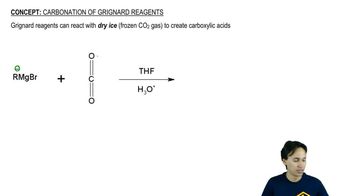
Carbonation of Grignard Reagents

Organocuprates

Organocuprates, or Gilman reagents, are organometallic compounds containing copper, typically represented as R2CuLi. They are less reactive than Grignard reagents and are used for selective carbon-carbon bond formation. In the reaction depicted, an organocuprate is employed to react with compound X, leading to the formation of compound Y through a nucleophilic addition.

Acid Workup

An acid workup is a common step in organic synthesis that involves the addition of an acid, such as H3O+, to neutralize basic reaction conditions and protonate intermediates. This step is crucial for converting reactive intermediates into stable products, such as alcohols. In the provided reaction scheme, the acid workup is essential for converting the Grignard and organocuprate reactions into the final alcohol products.
Recommended video:
Guided course
01:31
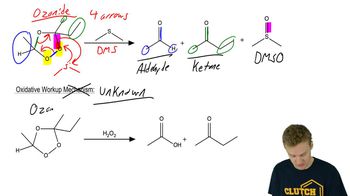
Oxidative Workup Mechanism: